Sol Video Inference Engine
Agent-Native Full-Stack Acceleration Framework for Efficient Video Generation
Sol Video Inference Engine: Agent-Native Full-Stack Acceleration Framework for Efficient Video Generation
一、论文概述
| 项目 | 内容 |
|---|---|
| 标题 | Sol Video Inference Engine: Agent-Native Full-Stack Acceleration Framework for Efficient Video Generation |
| 作者 | Yitong Li, Junsong Chen, Haopeng Li, Haozhe Liu, Jincheng Yu, Ligeng Zhu, Ping Luo, Song Han, Enze Xie |
| 机构 | NVIDIA Research, Efficient AI Team & Singapore Lab |
| 论文 | arXiv:2606.23743 |
| 代码 | github.com/NVlabs/Sol-Video-Inference-Engine |
| 项目页 | nvlabs.github.io/Sol-Video-Inference-Engine |
| 发布 | 21 Jun 2026 (v2: 24 Jun 2026) |
| 许可 | arXiv.org perpetual non-exclusive license |
二、核心思想
问题定义
现代视频扩散模型通过规模扩展不断提升生成质量,但这也导致推理成本大幅增加。视频扩散推理结合数十亿参数骨干网络、长时空序列和多步采样,计算代价极高。更关键的是,最有效的加速策略高度依赖具体部署实例(model, hardware, inference configuration)——一个组合下有效的方案往往无法迁移到另一个组合。
具体而言:
- 模型差异:不同模型在架构、数值敏感性、注意力集中度模式上各不相同
- 推理配置差异:空间/时间分辨率、视频时长、去噪调度、批处理策略等
- 硬件差异:从数据中心级高显存显卡到消费级边缘设备,支持的数值格式和内核吞吐量各异
这些因素共同构成了一个巨大的调优空间,使得手动性能工程成本极高。
解决方案概述
Sol Video Inference Engine 提出了一种 agent-native 的训练免费(training-free)全栈加速框架,将五种广泛适用的加速技术(cache、sparse attention、token pruning、quantization、kernel fusion)组织为可自动优化的加速栈。
核心工作流包含三个环节:
- 并行技能代理(Parallel skill agents):每个加速技术由独立的 skill agent 进行局部优化搜索
- 集成代理(Agent integrator):将各技术的候选方案组合成全局加速栈,解决技术间交互效应
- 人类验证器(Human validator):提供生成质量的视觉反馈,指导下一轮优化方向
该框架在三个不同规模和架构的视频模型上验证:64B Cosmos3-Super、22B LTX-2.3、2B SANA-Video,在 B200 GPU 上均实现了 2×–3× 的端到端加速,同时保持 VBench 质量指标几乎无损。
三、技术架构
整体框架图
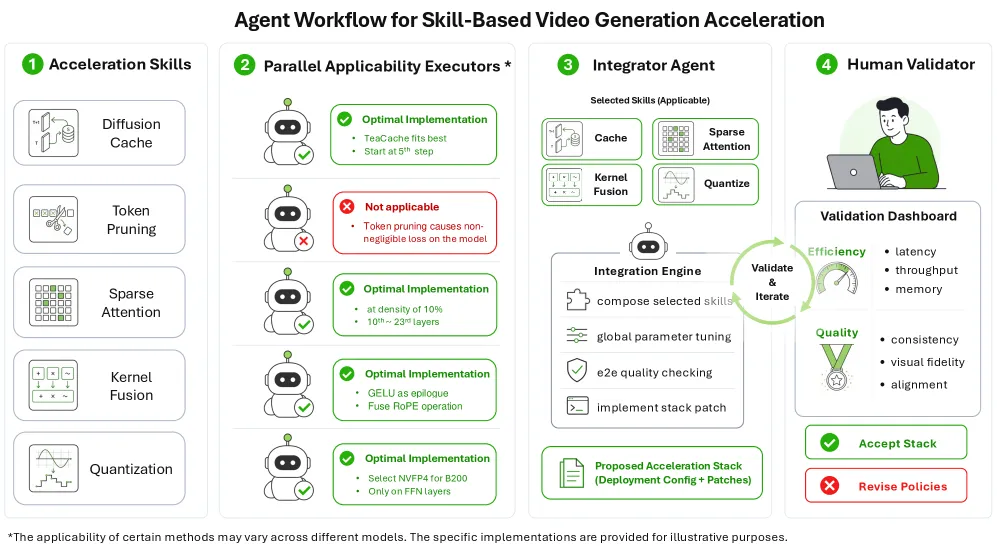
Sol Video Inference Engine 的整体架构围绕两个耦合部分展开:
- 全栈加速技术:覆盖算法层(cross-step cache)、模型层(sparse attention, token pruning)和内核层(quantization, kernel fusion)
- Agent-native 工作流:将传统上由多个团队分别完成的工作自动化
整个流程分为两阶段:
- Local parallel per-technique search:各 skill agents 独立探索各自的技术空间
- Global integration + human-validator loop:integrator 组合局部最优解为完整加速栈,人类验证器提供质量反馈
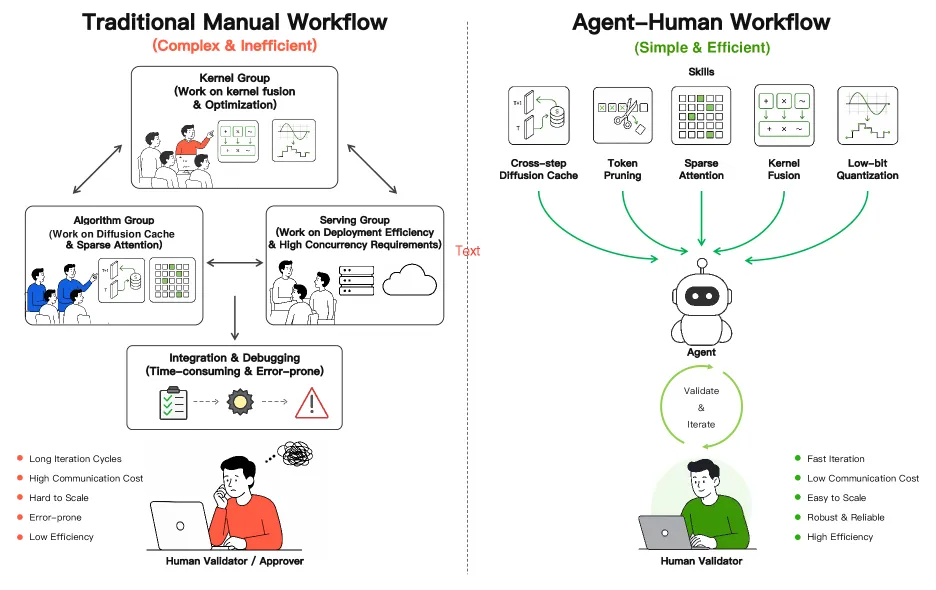
左图展示了传统手动加速工作流的痛点:不同专家团队分别优化不同技术,迭代周期长、沟通成本高、手动集成困难。右图展示了 Sol 的 agent-human 模式:agent 系统暴露加速技能,执行局部搜索和集成,人类主要做验证。
三层冗余分析
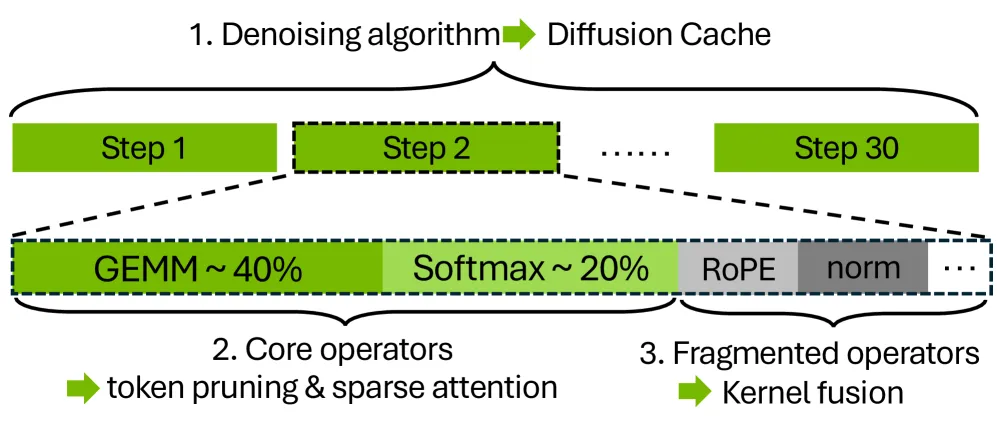
论文在 Section 3 系统分析了视频扩散推理中的三个层次的冗余:
算法层(Algorithm-level):相邻去噪步骤在缓慢变化的潜在状态上执行结构相似的计算,产生 cross-step 复用机会。扩散推理通常需要 30–50 个函数评估(NFE),相邻步骤产生相似的中间特征。
模型层(Model-level):长时空序列包含冗余 token 和注意力交互,每层每个 timestep 不需要完整的注意力图或全部 token。高分辨率/长视频场景下 token 数量极大,attention 的二次复杂度成为瓶颈。
内核层(Kernel-level):Transformer 推理中大量时间在 GEMM 周围的 memory-bound 算子上:布局转换、归一化、激活函数、精度转换等,这些操作算术强度低但 kernel launch 开销大。
部署异构性
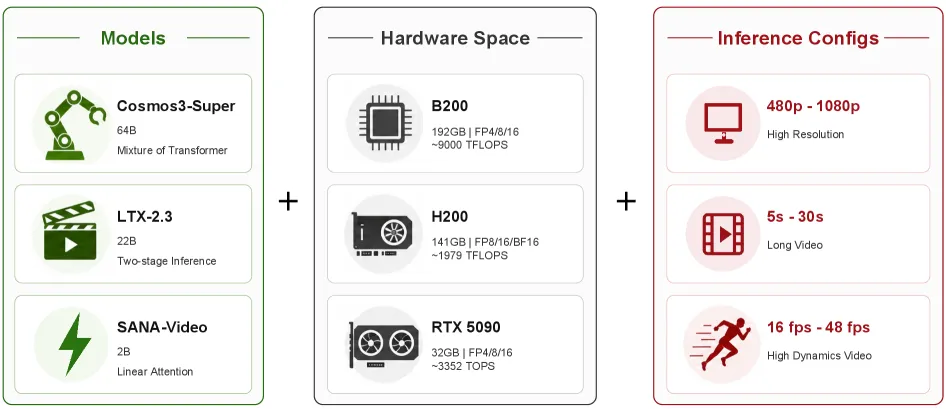
论文将加速目标定义为三维异构部署实例:(model, hardware, configuration)。
- Model:决定数值和结构敏感性。不同骨干网络有不同的量化鲁棒性、注意力冗余度、跨去噪步骤的 cache 稳定性、对 token pruning 的容忍度
- Hardware:决定暴露的瓶颈类型。高计算 GPU(如 B200)上大型 GEMM 可能足够快,此时小算子的 launch 开销和 memory-bound epilogues 占更大比例;低计算 GPU 上 dense compute 仍占主导
- Configuration:运行时选择如空间/时间分辨率(720p vs 1080p、24fps vs 48fps)。改变有效 token 数量和 runtime 平衡:增加分辨率会增加序列长度,attention 随 token 数二次增长,FFN/MLP 线性增长,因此 attention-FFN 时间分割在不同分辨率下显著变化
五大加速技术
1. Cross-Step Cache(跨步缓存)
扩散推理需要大量去噪步骤(通常 30–50 NFE)。Cross-step caching 通过跳过选定的去噪步骤计算并补偿跳过的输出来利用轨迹级冗余。
可选策略:
- TeaCache:从 timestep-conditioned 输入估计 step-to-step 输出变化,当预测变化小时复用 cached residuals
- EasyCache:runtime-adaptive 缓存策略,在线调整特征复用以平衡加速和质量
- TaylorSeer:用 Taylor 级数外推前几个 timestep 的特征,将特征复用扩展到特征预测
对于特定模型和部署配置,cache agent 需确定:哪种策略最合适、skip-step schedule、cached feature/residual 选择、补偿规则、warmup 策略、最大缓存步数约束。
2. Sparse Attention(稀疏注意力)
针对视频扩散推理中的大 spatiotemporal token 集,利用 temporal 和 spatial 冗余减少注意力计算。
可选方案:
- PISA:training-free piecewise sparse attention,关键块精确计算,非关键块用一阶 Taylor 近似补偿
- SpargeAttention:universal training-free 稀疏注意力框架,用 block-wise similarity metric 预测并跳过近零注意力条目
- Sparse VideoGen / Sparse VideoGen2:exploit spatial-temporal sparsity patterns with online profiling
Sparse attention agent 需调优:层选择(哪些层可稀疏化,哪些保持密集以保证质量)、稀疏模式、补偿策略。
3. Token Pruning(Token 剪枝)
通过 skip、merge 或重建冗余 latent token 来减少序列本身,降低后续 attention 和 feed-forward 计算。
可选方案:
- ToMe (Stable Diffusion):inference-time 合并冗余 diffusion tokens
- Astraea:为视频 DiT 在性能目标下搜索 token budgets
- TAPE:跨帧平滑 token 重要性以避免 temporal jitter
- CoReDiT:prune spatially coherent DiT tokens 同时重建跳过输出以保持密集表示
Token pruning agent 需调优:pruning criterion、pruning ratio、layer schedule、timestep schedule、reconstruction rule。
4. Quantization(量化)
量化加速效果受模型隐藏维度、推理 token 数和硬件特性严重影响。模型的量化噪声敏感性由训练参数分布决定。
可选方案:
- PTQ4DiT:识别 salient channels 和 timestep-varying activations 作为后训练量化的关键挑战
- Q-DiT:自动量化粒度分配
- SVDQuant:用 low-rank components 吸收 weight 和 activation outliers,实现 4-bit 扩散推理
- SageAttention:target attention quantization,8-bit 到 4-bit attention 加速 with outlier smoothing
Quantization agent 需调优:layer-wise precision assignments、weight 和 activation bitwidths、timestep-dependent scaling。
5. Kernel Fusion(内核融合)
将 memory-bound 的碎片化算子(bias addition、residual updates、normalization、activation functions、scaling、layout conversion)融合执行,避免中间结果 materialize 到 HBM。
典型融合候选:
- GEMM + GELU(epilogue fusion)
- GEMM + residual
- Fused RoPE + norm
- QKV-path fusion
- Normalization-path fusion
参考实现:CUTLASS epilogue programming、ByteTransformer、CODA(将 transformer blocks 重写为 GEMM-plus-epilogue programs)。
加速分解

全栈加速不是单一技术的简单叠加,而是五个组件的渐进式累积效果:cache → sparse attention + token pruning → kernel-level optimization。
Human Validator 的必要性
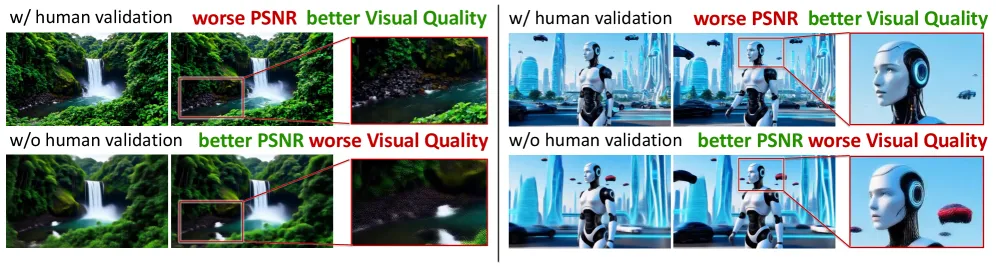
PSNR 等相似度指标与人类视觉感知不一致。给定高质量参考视频,PSNR 可能对 shifted visual details 分配大距离,而对 blur/temporal jitter/degraded motion 分配小距离。前者人类可接受而后者不可接受,因此人类反馈必不可少。
四、核心创新
| 创新点 | 说明 | 理论/实验依据 |
|---|---|---|
| 问题重构 | 将视频扩散加速从一次性优化问题重新定义为 instance-specific tuning 问题 | Section 3 的系统分析,展示 model/hardware/configuration 三维组合空间的巨大规模 |
| Agent-native 工作流 | 用 skill agents + integrator agent + human validator 替代多团队协作 | 三个模型上的自动化加速栈构建,人工投入极小 |
| Full-stack 集成 | 五个加速技术的协同组合,而非单点优化 | Table 1 显示 2×–3× 累积加速,单一技术无法达到 |
| Instance-specific 搜索 | 每种技术针对具体部署实例调优,不追求通用方案 | 不同模型选择不同的 cache 策略(TeaCache vs EasyCache)、不同的量化范围 |
五、代码实现分析
项目结构
GitHub 仓库: https://github.com/NVlabs/Sol-Video-Inference-Engine
整体实现原则
所有三个模型共享相同的部署接口结构:
- Dense baseline path:未加速的 SGLang 基线
- Composed full-opt path:由加速组件组成的优化路径
运行时基于 SGLang,优化路径根据各模型架构和瓶颈选择性替换:cache reuse、sparse/reduced token computation、low-precision kernels、fused operator sequences。
全局实现原则
- Cache:始终作为 training-free denoising-step reuse policy,但 exact schedule 因模型而异
- Sparse attention:仅在 attention map 有足够结构时引入,用 piecewise sparse pattern 替换 dense bidirectional attention
- Token pruning:仅在 intermediate video tokens 有足够冗余时使用
- Quantization:selective 而非 uniform,数值脆弱阶段保持高精度,stable GEMM-heavy 区域使用低精度
- Kernel optimization:selective,包括 epilogue fusion、QKV-path fusion、normalization-path fusion、compiler-driven graph fusion
各模型具体管线
Cosmos3-Super (64B, MoT 架构, 4×GPU)
- Cache: TeaCache-style residual replay,threshold=1.15, start_step=10, max 3 continuous cache hits。测量 generation hidden state 相对 L1 变化
- Quantization: Step-selective。前 3 和后 3 步保持 dense/high-precision path,中间步骤应用 NVFP4 到 GEMM-heavy generation-path linear layers(FFN gate-up/down projections, attention QKV/output projections)
- Kernel: GEMM-heavy middle part 优化
LTX-2.3 (22B, Two-stage, 1×GPU)
- Stage 1 (544×960, 15 steps, res_2s sampler): Fixed-step cache
8of15_last_29calls— 29 次 denoiser calls 中复用最后计算结果于索引 [13,14,16,17,18,19,20,21,22,24,25,26,27] - Stage 2 (1088×1920, 3 steps): PISA sparse attention 仅用于 high-resolution refinement transformer,sparsity=0.9, block_size=64, 仅替换 video self-attention
- Token pruning: 仅限 stage 2,refinement calls 1 和 2 保留 50% video tokens(按 feat_norm saliency score)
- Quantization: NVFP4 仅用于 video FFN input/output projections
- Fusion: 多项 lossless fusion flags(block-0 self-attention sharing, guidance-prefix sharing, fused QK+RoPE, fused RMS-AdaLN, fused AdaLN 等)
- LoRA: distilled LoRA strengths = 0.25 (stage 1), 0.5 (stage 2)
SANA-Video (2B, Linear Attention, 1×GPU)
- 不使用的技术: sparse attention, token pruning, NVFP4 FFN quantization(因模型已高度优化)
- Cache: EasyCache,threshold=0.1, warmup=3 steps, spatial subsample stride=8
- Kernel: BF16 linear attention tensor-core execution(而非 FP32)、self-attention Q/K/V 合并为一个 GEMM(concat projection weights)、torch.compile 编译 DiT block stack
- 效果: 50 steps 中约 16 个 skipped,剩余加速来自 BF16 linear attention、QKV merge、compile/fusion
六、实验结果
实验设置
- 硬件: NVIDIA B200 GPUs(Cosmos3-Super 用 4×GPU with sequence parallelism,LTX-2.3 和 SANA-Video 各 1×GPU)
- 基线: SGLang-based serving stack
- 主指标: 端到端延迟(end-to-end latency)
- 质量指标: VBench(visual quality + motion quality)
基准测试
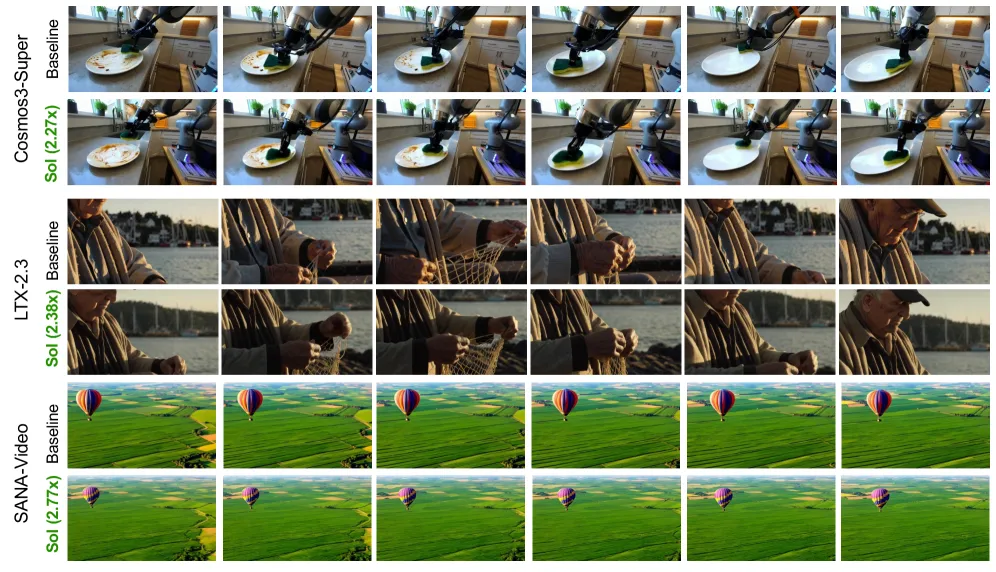
表1:端到端加速结果(NVIDIA B200)
| Framework | Cosmos3-Super (64B, 4×GPU) | LTX-2.3 (22B) | SANA-Video (2B) | |||
|---|---|---|---|---|---|---|
| Latency (s) | Speedup | Latency (s) | Speedup | Latency (s) | Speedup | |
| Official | 108.3 | – | 118.1 | – | 34.2 | – |
| SGLang | 99.6 | 1.00× | 97.8 | 1.00× | 29.4 | 1.00× |
| Sol-Engine | 43.9 | 2.27× | 41.0 | 2.38× | 10.6 | 2.77× |
各模型累积加速过程:
Cosmos3-Super: SGLang 99.6s → Cache (TeaCache) 52.4s (1.90×) → Kernel optimization 43.9s (2.27×) LTX-2.3: SGLang 97.8s → Cache 70.3s (1.39×) → Sparse attn + Token prune 58.5s (1.67×) → Kernel + NVFP4 41.0s (2.38×) SANA-Video: SGLang 29.4s → Cache (EasyCache) 19.8s (1.48×) → BF16 LA + QKV merge + compile 10.6s (2.77×)
B300 扩展: 单卡 Cosmos3-Super 在 B300 上从 351.9s 降至 137.6s (2.56×),比 B200 上的 2.46× 更高,因为 Cosmos3-Super 更依赖 NVFP4 执行而 B300 的 NVFP4 能力更强。
表2:VBench 质量评估
| Model | Metric | Baseline | Sol-Engine | Δ |
|---|---|---|---|---|
| Cosmos3-Super | Avg Score | 0.7759 | 0.7775 | +0.21% |
| Subject Consistency | 0.9687 | 0.9723 | +0.37% | |
| Background Consistency | 0.9301 | 0.9382 | +0.87% | |
| Temporal Flicker | 0.9859 | 0.9877 | +0.18% | |
| Motion Smoothness | 0.9923 | 0.9935 | +0.12% | |
| Aesthetic Quality | 0.6134 | 0.6197 | +1.03% | |
| Imaging Quality | 0.7276 | 0.7178 | -1.35% | |
| Overall Consistency | 0.2133 | 0.2133 | +0.00% | |
| LTX-2.3 | Avg Score | 0.7646 | 0.7605 | -0.54% |
| Subject Consistency | 0.9010 | 0.9006 | -0.04% | |
| Background Consistency | 0.9245 | 0.9137 | -1.17% | |
| Temporal Flicker | 0.9675 | 0.9704 | +0.30% | |
| Motion Smoothness | 0.9871 | 0.9840 | -0.31% | |
| Aesthetic Quality | 0.6234 | 0.6104 | -2.09% | |
| Imaging Quality | 0.7012 | 0.7013 | +0.01% | |
| Overall Consistency | 0.2474 | 0.2429 | -1.82% | |
| SANA-Video | Avg Score | 0.7864 | 0.7847 | -0.21% |
| Subject Consistency | 0.9730 | 0.9750 | +0.21% | |
| Background Consistency | 0.9648 | 0.9654 | +0.06% | |
| Temporal Flicker | 0.9626 | 0.9646 | +0.21% | |
| Motion Smoothness | 0.9843 | 0.9842 | -0.01% | |
| Aesthetic Quality | 0.6650 | 0.6624 | -0.39% | |
| Imaging Quality | 0.6892 | 0.6779 | -1.64% | |
| Overall Consistency | 0.2660 | 0.2637 | -0.86% |
关键发现:平均分数变化均在 ±0.5% 以内,证明加速确实来自消除冗余/低效操作而非牺牲感知关键计算。
定性对比
Figure 8–10 展示了六个 matched video pairs(每模型两个),upper strip 为未加速 SGLang 结果,lower strip 为 Sol-Engine 结果。加速输出可能在细微视觉细节上有微小差异,但整体视觉质量、运动质量和物理保真度保持良好。
七、相关工作
视频扩散模型
主流开源模型包括 CogVideo/CogVideoX、Wan 系列、HunyuanVideo、Cosmos3-Super。长上下文和高分辨率场景下,LongCat-Video、LTX-2.3、JoyAI-Echo、Pyramid Flow 采用 multi-stage/autoregressive/memory-augmented pipeline。SANA-Video 则通过 linear attention 追求极致效率。尽管架构多样,所有系统面临相同的推理瓶颈。
视频生成加速
- 算法层:TeaCache、EasyCache、TaylorSeer、PAB 等 cache 方法
- 模型层:PISA、Sparse VideoGen/2、VSA、SpargeAttention、ToMe、Astraea、TAPE、CoReDiT 等 sparse attention 和 token reduction
- 内核层:PTQ4DiT、Q-DiT、ViDiT-Q、SVDQuant、FP4 exploration、CUTLASS epilogues、ByteTransformer、CODA
Agentic Workflows
AgentBench、MLAgentBench、SWE-agent、AutoCodeRover、Agentless、OpenHands、AI Harness Engineering、The AI Scientist、CUDA-LLM、CudaForge。Sol 与此方向一致,但 targeting 协调多个加速技能用于视频扩散推理。
八、总结
核心贡献
- Problem reformulation:系统分析视频扩散推理的加速空间,将其形式化为 instance-specific tuning problem 而非一次性优化
- Full-stack acceleration framework:综合框架,整合 algorithmic 和 system-level 技术(cross-step caching、sparse attention、token pruning、quantization、kernel fusion)
- Agent-driven optimization workflow:Agent-native 架构,编排 parallel agents 和 integrator,绕过传统多团队工程需求
- Extensive empirical validation:训练免费的框架在多样化 SOTA 模型上实现超过 2× 端到端加速,不损害视觉质量
技术影响
- 展示了 agent-native 全栈加速可以减少推理成本而人工投入极小
- 框架不绑定单一 backbone,可泛化到不同规模(2B–64B)和不同架构(MoT、two-stage、linear attention)的视频扩散模型
- 为未来自动化性能工程提供了范式
局限性
- 依赖人类判断:最终质量评估仍需人类反馈,PSNR 等自动指标与人类视觉感知不一致
- 未来方向:learned video preference models、artifact detectors、physics-consistency checks、VLM-based end-to-end quality judgment 可减少人工验证需求,使框架更自主