PRR: Predict, Reuse, and Repair — Accelerating Dynamic Sparse Attention for Long-Context LLM Decoding
一种基于 EMA 预测器和在线 Softmax 增量修复的投机注意力运行时,打破 DSA 中 selection-to-attention 的关键路径依赖
PRR: Predict, Reuse, and Repair — Accelerating Dynamic Sparse Attention for Long-Context LLM Decoding
一、论文概述
| 项目 | 内容 |
|---|---|
| 标题 | Predict, Reuse, and Repair: Accelerating Dynamic Sparse Attention for Long-Context LLM Decoding |
| 作者 | Tianyu Wang, Gourav Rattihalli, Aditya Dhakal, Junbo Li, Zhiwei Ren, Dejan Milojicic, Longfei Shangguan |
| 机构 | 1 University of Pittsburgh, Pittsburgh, PA, USA; 2 HPE Labs, Milpitas, CA, USA |
| 论文 | arXiv:2606.30389 |
| 代码 | github.com/Tianyu9748/Incremental_FlashAttention |
| 发布 | 2026-06-29 (cs.LG) |
| 许可 | BSD-3-Clause |
核心贡献:
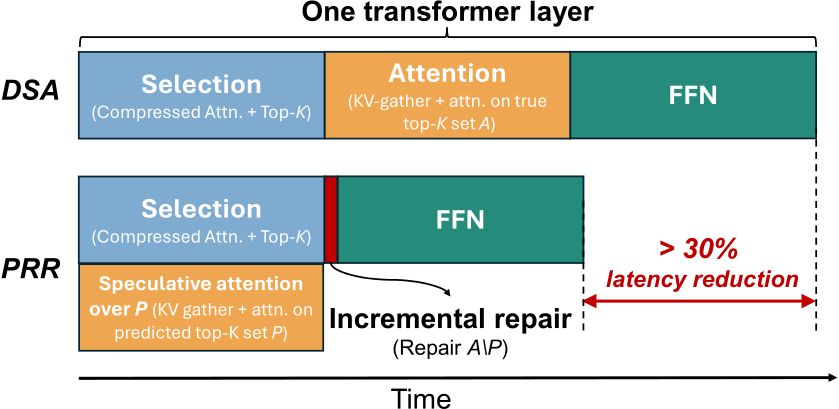
- 发现 DSA(Dynamic Sparse Attention)引入的新瓶颈:selection-to-attention dependency——每个 decoding step 中 selection 严格串行在 attention 之前,占 per-token 生成延迟高达 41%
- 提出 PRR(Predict, Reuse, Repair),一个 correctness-preserving 的投机注意力运行时,利用 DSA 选择的时序局部性(~68% 块重复率),在 selection 进行时并行执行 speculative attention
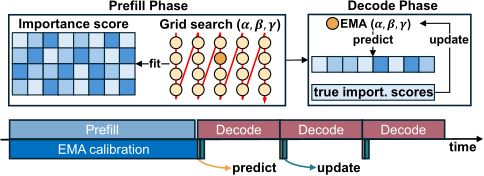
- 设计轻量级 EMA-based predictor,通过 prefill 阶段的 importance score 轨迹进行 prompt-adaptive 超参数校准,预测精度达 ~91%(优化后 ~98%)
- 实现基于 FlashAttention online-softmax recurrence 的定制化 CUDA kernel,支持 incremental repair——将 missed blocks 的贡献精确合并到已有 accumulator,无 accuracy loss
- 在 6 个 LLM 和 5 个 long-context benchmarks 上的评估表明:相比 Quest 平均加速 1.42×,相比 InfLLM-v2 平均加速 1.56×,同时保持相同下游任务准确率
二、核心思想
问题定义
DSA(如 Quest、InfLLM-V2)通过在每个 decoding step 只选择 top-K KV blocks 来加速长上下文 LLM 推理。但这引入了一个新的关键路径瓶颈:selection-to-attention dependency。
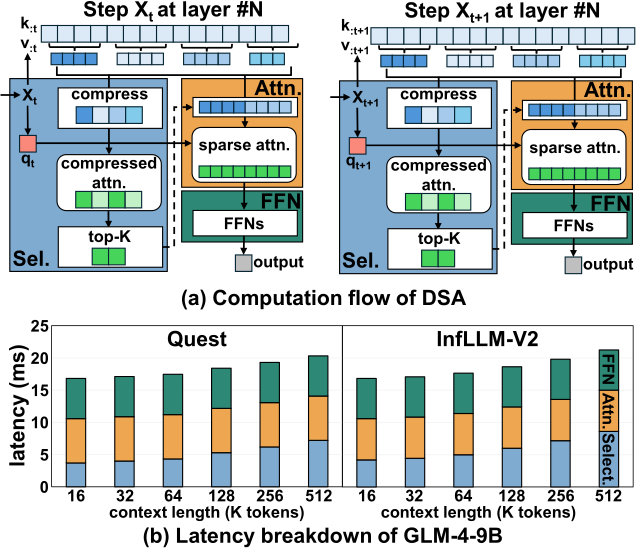
具体而言,每个 decoding step 包含三个阶段:
- Selection:运行 compressed attention,识别 top-K 个最相关的 KV block
- Attention:仅对选中的 top-K blocks 执行稀疏 attention
- FFN:标准前馈层
由于 block identities 在 selection 完成前未知,attention 严格串行等待 selection 结束。随着 context length 增长,这一依赖变得日益昂贵——selection 占 per-token generation latency 高达 41%。
解决方案概述
PRR 的核心洞察:DSA 的 block 选择具有显著的时序稳定性(temporal locality)。实验测量表明,约 68% 的 selected blocks 在连续 decoding steps 间被重复选择。
PRR 利用这一特性,采用三步策略:
- Predict:使用轻量级 EMA predictor 预测当前 step 的 top-K blocks,提前执行 speculative attention
- Reuse:speculative attention 与 selection 并行执行,覆盖预测命中块的 attention 计算
- Repair:当真实 top-K 集合 A 已知后,对 missed blocks M = A \ P 执行 incremental attention repair,将贡献精确合并到已有 accumulator
最终 attention 输出覆盖完整的 true selected set A,与标准 DSA 语义等价,accuracy 无损。
三、技术架构
整体框架
PRR 由三个核心组件构成:
| 组件 | 功能 | 关键技术 |
|---|---|---|
| EMA Predictor (§4.1) | 预测下一个 decoding step 的 top-K blocks | 双指数平滑 + prompt-adaptive 超参数校准 |
| Incremental Repair Kernel (§4.3) | 将 missed blocks 精确合并到 partial attention | FlashAttention online-softmax recurrence |
| Speculation Budget (§4.4) | 控制 speculative work 不超过 critical path | profile-guided dynamic budget ratio δ |
Motivation
Selection-to-Attention Dependency (§2.1)
DSA 每个 decoding step 包含三个阶段:selection → attention → FFN。Selection 阶段需要运行 compressed attention 来识别 top-K KV blocks。由于 block identities 在 selection 完成前不可知,attention 严格串行等待。
Temporal Locality of Block Selection (§2.2)
在五个 long-context benchmarks 上测量连续 decoding steps 间的 block overlap rate:
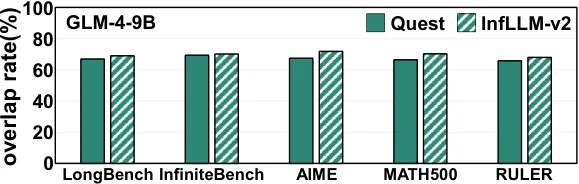
关键发现:两种 DSA 方法在所有 benchmark 上均稳定重选超过 65% 的 blocks,平均重叠率约 68%。
GPU Headroom (§2.2)
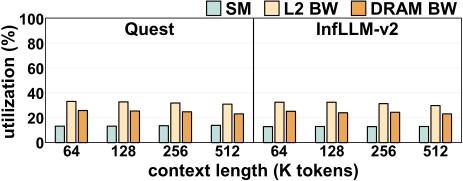
关键发现:即使在高 context 长度下,GPU SM、L2-BW 和 DRAM-BW 利用率均低于 40%,说明有充足的空闲资源执行 speculative attention 而不会与 critical path 竞争。
核心公式
EMA Predictor (§4.1)
PRR 使用训练-free 的轻量级 EMA predictor,直接操作 DSA 产生的 block importance scores。
令 为 decoding step 中 block 的真实 importance score。在 step 的 selection 阶段运行之前,PRR 使用历史分数预测 。
预测阶段(extrapolation):
其中 控制如何激进地外推近期趋势。
更新阶段(update):
其中 控制 level 跟随新分数的速度, 控制 trend estimate 适应分数变化的速度。
当 block 首次进入 KV cache 时(step ),初始化 ,。
Prompt-Adaptive Hyperparameter Calibration (§4.2)
固定超参数 对不同 prompt 效果差异大。PRR 在 prefill 阶段进行 per-prompt 校准:
令 为 prefill token 数量, 为 prefill 阶段产生的 importance score 矩阵(row 是 prefill token 处的 compressed-attention score vector)。
对候选超参数 ,模拟 predictor 过 ,产生 predicted selection set ,测量 score-weighted hit rate:
其中 是 prefill token 处的 ground-truth top-K block selection set, 是 block 在 token 处的 importance score。
最优超参数选择:
搜索网格:(步长 0.2)、(步长 0.1)、(步长 0.25),共 80 个候选。搜索与 prefill 阶段重叠,仅增加 0.06 ms 额外延迟。
Incremental Repair via Online Softmax (§4.3)
Mispredictions 不可避免(),忽略 会产生不精确的 softmax 输出且误差随 decoding steps 累积。
PRR 实现定制化 CUDA kernel,基于 FlashAttention 的 online-softmax recurrence 进行 incremental repair。给定 speculative attention 的输出 和 missed blocks 的 KV 条目,第二个 kernel 应用以下 recurrence:
其中 是 missed blocks 的 running max 和 log-sum-exp, 和 是 missed blocks 的 attention scores 和 values。
关键实现细节:
- Speculative kernel 额外存储 output 、denominator 和 running maximum 到 HBM
- 修改是 surgical 的:inner-loop arithmetic 不变,额外存储仅为每 head 两个 scalars
- Missed blocks 以 tiled 方式 stream through on-chip memory,不 materialize intermediate score matrix
- Both FLOPs 和 memory traffic 仅随 缩放
Speculation Budget Optimization (§4.4)
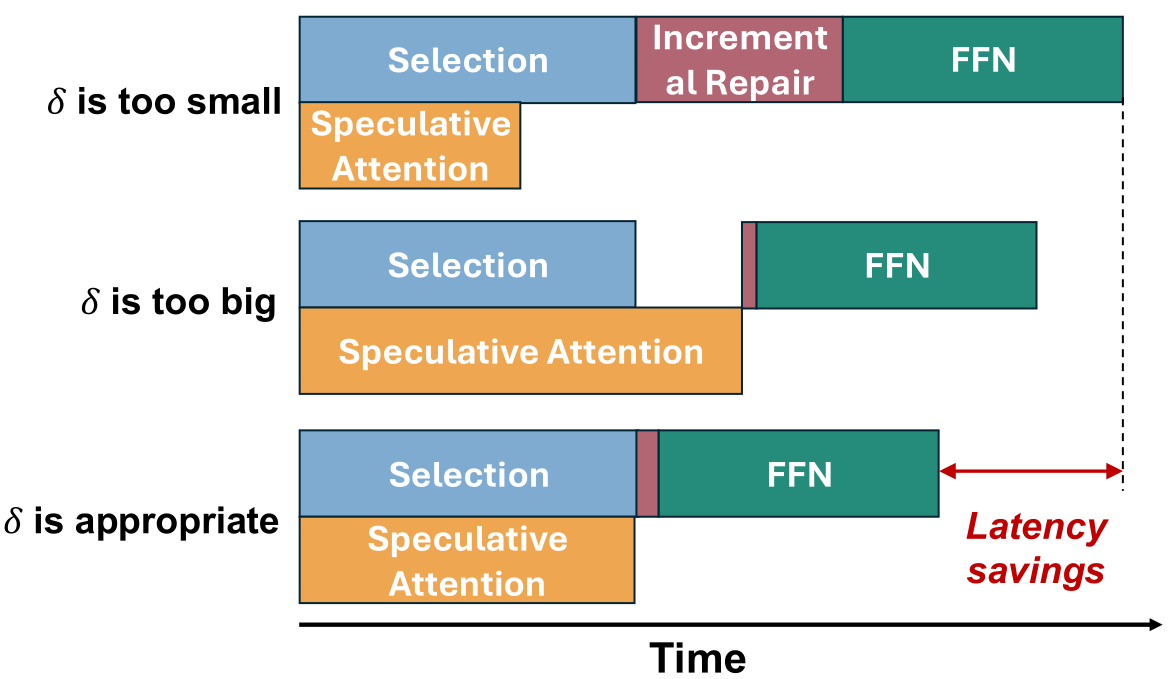
增大 speculation budget 可覆盖更多 true selected blocks并减少 missed blocks,但也会增加 speculative KV movement 和 attention computation,可能延长 critical path。
PRR 将预算约束表述为优化问题:
其中 是 speculation budget ratio。PRR 采用 profile-guided 方法:对每个 model-hardware-DSA 配置进行一次 offline profiling sweep,测量 selection latency 和 speculative-attention latency 在不同 context lengths 和 下的值,动态选择 使 speculative attention latency 适配当前 selection window。
Profiling 的 context lengths:4K, 8K, 16K, 32K, 64K。
设计空间探索
PRR 解决两个核心挑战:
- Temporal locality alone is not sufficient:盲目重用前一步的 top-K block indices 仅获得 modest hit rate。需要更智能的 predictor。
- Speculation must preserve DSA result:最终 attention 必须在 true DSA-selected set 上计算。现有引擎(vLLM、SGLang)和 attention kernels(FlashAttention)不支持将 missed blocks 增量合并到 partial attention result。
四、核心创新
| 创新点 | 说明 | 理论/实验依据 |
|---|---|---|
| Selection-to-attention dependency 识别 | 首次将 DSA 的 latency bottleneck 定位为 selection→attention 串行依赖 | §2.1: selection 占 per-token 延迟 41% |
| EMA-based block predictor | 训练-free 的轻量级 predictor,直接操作 DSA importance scores | Eq. (2)-(3): 双指数平滑,~68% base overlap |
| Prompt-adaptive calibration | Prefill 阶段 per-prompt 超参数搜索,无需在线训练 | Eq. (4)-(5): grid search over 80 candidates, 0.06ms overhead |
| Incremental repair kernel | 基于 FlashAttention online-softmax 的定制化 CUDA kernel | Eq. (6): exact combine, no accuracy loss |
| Critical-path-aware budget | Profile-guided dynamic δ 确保 speculative work 不超出 selection window | Fig. 5: balanced timeline |
五、代码实现分析
项目结构
Incremental_FlashAttention/
├── hopper/                          # FA-3 (CUTLASS 3.x, SM90 TMA+WGMMA+WS) — 主要 sparse 工作区
│   ├── mainloop_fwd_sm90_tma_gmma_ws.hpp   # Forward mainloop with sparse dispatch (~131KB)
│   ├── flash_fwd_kernel_sm90.h             # Forward kernel with sparse_block_table support
│   ├── flash_fwd_combine.cu                # Combine kernel for speculative+sparse merge
│   ├── flash_fwd_combine_kernel.h          # Combine kernel header
│   ├── flash_attn_interface.py             # Python entry point
│   └── sparse_flash_attn_3/               # Renamed package namespace
├── csrc/flash_attn/              # FA-2 kernels (CUTLASS 2.x) — Ampere fallback
├── sparse_flash_attn_2/          # FA-2 Python package (renamed)
├── tests/                        # Correctness tests
├── benchmarks/                   # Performance benchmarks
├── setup.py                      # Build configuration
└── instruction.md               # Build instructions
关键实现文件
| 文件 | 说明 | 大小 |
|---|---|---|
hopper/mainloop_fwd_sm90_tma_gmma_ws.hpp | FA-3 forward mainloop,含 load_sparse() + mma_sparse() sparse block dispatch | 131KB |
hopper/flash_fwd_kernel_sm90.h | Forward kernel template,支持 sparse_block_table 参数 | 29KB |
hopper/flash_fwd_combine.cu | Exact combine kernel,合并 speculative 和 repair partials | 929B |
hopper/flash_fwd_combine_kernel.h | Combine kernel header,online-softmax recurrence 实现 | 26KB |
API 接口
# 1. Sparse-only forward
from flash_attn_interface import flash_attn_with_sparse_block_table
out, lse = flash_attn_with_sparse_block_table(q, k, v, sparse_block_table, block_size=128)

# 2. Speculative + sparse with exact combine
from flash_attn_interface import flash_attn_speculative_sparse
out, lse = flash_attn_speculative_sparse(q, k_spec, v_spec, k, v, sparse_block_table, causal_spec=True)
硬件要求
- FA-3 sparse path: NVIDIA Hopper GPU (H100/H800, SM90)
- FA-2 path: Ampere (SM80) 兼容
- CUDA: ≥ 12.3 (推荐 12.8)
- Precision: FP16/BF16 (half precision)
六、实验结果
实验设置
| 配置项 | 值 |
|---|---|
| GPU | NVIDIA H100, CUDA 12.8, TP=2 |
| Models | GLM-4-9B, GLM-Z1-9B, DeepSeek-R1-8B, Llama3-8B, Qwen3-14B, Qwen3-32B |
| DSA Methods | Quest, InfLLM-v2 |
| Benchmarks | LongBench, InfiniteBench, RULER, AIME, MATH500 |
| Backend | FlashInfer’s BlockSparseAttention |
DSA Speedup over Serial Execution (Table I)
| Model | LongBench | InfiniteBench | RULER | AIME | MATH500 | Avg. |
|---|---|---|---|---|---|---|
| Quest | ||||||
| GLM-4 | 1.50× | 1.40× | 1.45× | 1.30× | 1.42× | 1.42× |
| GLM-Z1 | 1.48× | 1.39× | 1.43× | 1.33× | 1.45× | 1.42× |
| DeepSeek-R1 | 1.39× | 1.42× | 1.47× | 1.35× | 1.39× | 1.41× |
| Llama3 | 1.36× | 1.40× | 1.41× | 1.39× | 1.34× | 1.38× |
| Qwen3-14B | 1.44× | 1.27× | 1.41× | 1.44× | 1.45× | 1.40× |
| Qwen3-32B | 1.26× | 1.34× | 1.27× | 1.27× | 1.26× | 1.28× |
| InfLLM-v2 | ||||||
| GLM-4 | 1.64× | 1.38× | 1.58× | 1.62× | 1.59× | 1.56× |
| GLM-Z1 | 1.61× | 1.35× | 1.61× | 1.64× | 1.55× | 1.55× |
| DeepSeek-R1 | 1.30× | 1.48× | 1.61× | 1.52× | 1.28× | 1.44× |
| Llama3 | 1.32× | 1.45× | 1.55× | 1.55× | 1.30× | 1.43× |
| Qwen3-14B | 1.56× | 1.43× | 1.51× | 1.53× | 1.53× | 1.51× |
| Qwen3-32B | 1.35× | 1.27× | 1.29× | 1.32× | 1.35× | 1.31× |
关键发现: PRR 在 Quest 上平均加速 1.35×,在 InfLLM-v2 上平均加速 1.47×。较小模型(9B)增益更大,Qwen3-32B 增益较低但仍显著。
Temporal Locality Overlap Rate (Table IV)
| Model | LongBench | InfiniteBench | RULER | AIME | MATH500 | Avg. |
|---|---|---|---|---|---|---|
| Quest (GLM-4) | 98.65% | 96.86% | 98.36% | 98.15% | 98.25% | 98.05% |
| InfLLM-v2 (GLM-4) | 97.86% | 97.14% | 96.46% | 98.15% | 98.01% | 97.52% |
Ablation Study (Table II)
| Benchmark | S1 (Reuse prev) | S2 (+Repair Kernel) | S3 (Full PRR) |
|---|---|---|---|
| LongBench | 1.02× | 1.34× | 1.64× |
| InfiniteBench | 1.00× | 1.19× | 1.38× |
| RULER | 1.01× | 1.34× | 1.58× |
| AIME | 1.02× | 1.34× | 1.62× |
| MATH500 | 1.01× | 1.31× | 1.59× |
| Avg. | 1.01× | 1.30× | 1.56× |
关键发现:
- S1(简单重用前一步 selection)几乎无改善——单个 missed block 触发 full recomputation 抵消了 speculation 收益
- S2(引入 repair kernel)将 avg speedup 提升至 1.30×
- S3(完整 PRR)达到 1.56× avg speedup,EMA predictor 将 overlap rate 从 91% 提升至 98%
Kernel Speed Comparison (Table III)
| Block Size | 1024 tokens | 2048 | 4096 | 6144 | 8192 | Avg. |
|---|---|---|---|---|---|---|
| 16 | 1.17× | 1.28× | 2.00× | 2.83× | 3.68× | 2.19× |
| 32 | 1.17× | 1.38× | 2.09× | 2.78× | 3.69× | 2.22× |
| 64 | 1.17× | 1.38× | 2.26× | 2.91× | 3.64× | 2.27× |
| 128 | 1.17× | 1.41× | 2.23× | 3.00× | 3.71× | 2.31× |
| 256 | 1.03× | 1.11× | 2.00× | 2.75× | 3.64× | 2.11× |
关键发现: PRR 的 sparse kernel 在大多数 block size 和 token budget 组合下显著优于 FlashInfer 的 BlockSparseAttention。Token budget 越大,speedup 越高(最大 3.71× @ 8192 tokens)。
三大增益机制
- EMA predictor 达到 ~91% average top-K overlap rate,使大部分 speculative attention work 被利用
- Customized sparse kernel 大幅超越 BlockSparseAttention(avg 2.2× headroom),使 PRR 能在 speculation 中包含更多 blocks,将 overlap rate 从 91% 提升至 98% 且不增加延迟
- Incremental repair 而非 full recomputation,保留 speculation 的 latency savings
七、相关工作
KV Cache Retrieval for DSA
- KV-dropping methods(如 Sinkhorn Attention 等):通过丢弃不重要的 KV tokens 节省内存,但有信息丢失
- KV retrieval approaches(LouisKV, AsyncSpade):将完整 KV cache 保存在 CPU 内存,按需 fetch query-relevant tokens。与 PRR 正交
- LouisKV / AsyncSpade:通过预测 query state prefetch relevant tokens,但近似估计可能 drop important tokens 并降低质量。PRR 基于 temporal locality of historical importance scores,且 repair 保证 zero accuracy degradation
Temporal Locality for KV Cache Management
- FlexiCache:exploit temporal stability across heads——stable heads 仅保留 top-K KV pages on GPU,unstable heads 保留全部。与 PRR 互补且可组合:PRR 的 EMA predictor 可指导 FlexiCache stable heads 内的页面保留策略
Dynamic Sparse Attention
- Quest:基于 compressed attention 的 top-K block selection
- InfLLM-v2:基于 inference-time KV page eviction 的 DSA
- NSA(Neural Sparse Attention):需从头训练的 trainable DSA,PRR 未包含(需巨大计算资源)
八、总结
核心贡献
- 瓶颈识别:首次将 DSA 的 selection-to-attention dependency 识别为新的 critical-path bottleneck,selection 占 per-token 延迟高达 41%
- PRR 运行时:提出 correctness-preserving 的 speculate-reuse-repair runtime,打破 selection→attention 串行依赖
- EMA Predictor:轻量级训练-free predictor,通过 prefill 阶段 prompt-adaptive 校准,达到 ~98% overlap rate
- Incremental Repair Kernel:基于 FlashAttention online-softmax recurrence 的定制化 CUDA kernel,exact combine,无 accuracy loss
- 显著性能提升:6 个 LLM × 5 个 benchmark 上,Quest 平均 1.42×、InfLLM-v2 平均 1.56× 加速
局限性
- 仅评估 training-free DSA:仅评估 Quest 和 InfLLM-v2,未包含 trainable 方法如 NSA(需巨大计算资源从头训练)
- 单一 GPU 架构:仅针对 NVIDIA Hopper (SM90) 和 half precision 优化 kernel。可扩展至 Blackwell 和其他低精度(如 fp8)
- 仅 batch size 1:仅评估 batch size 1 场景。未来可探索 batch 内多请求间的 coordination
- 主文仅展示 GLM-4-9B:其他模型的完整结果在 Appendix A 中
未来方向
- 扩展 kernel optimization 至其他 GPU 架构(Blackwell)和精度(fp8)
- 集成 trainable DSA mechanisms(如 NSA)
- 探索 batch 内多请求的 stage coordination 以提升 decoding throughput
- 与 FlexiCache 等 temporal locality 方法组合
九、参考资源
- 论文: arXiv:2606.30389
- 代码: github.com/Tianyu9748/Incremental_FlashAttention
- FlashAttention: github.com/Dao-AILab/flash-attention
- FlashInfer: github.com/flashinfer-ai/flashinfer
- Quest: Tang et al. “Quest: Quantile-based Efficient Streaming Attention for Long-context LLMs”
- InfLLM-v2: Zhao et al. “InfLLM: Infinite Context Length Streaming Attention for Large Language Models”
附图索引
| 编号 | 文件名 | 说明 |
|---|---|---|
| Figure 1 | figures/prr-dsa/figure-01-teaser.svg | Standard DSA vs PRR: serial selection→attention→FFN vs parallel speculative attention + incremental repair |
| Figure 2 | figures/prr-dsa/figure-02-latency-breakdown.svg | (a) DSA 三阶段与时序相似性;(b) Quest/InfLLM-V2 延迟分解 |
| Figure 3 | figures/prr-dsa/figure-03-hit-rate.png | 各 benchmark 下连续 selection 的块重叠率 (~68%) |
| Figure 4 | figures/prr-dsa/figure-04-utilization.svg | SM/L2-BW/DRAM-BW 利用率 profiling (<40%) |
| Figure 5 | figures/prr-dsa/figure-05-choose-alpha1.svg | Speculation budget ratio δ 对执行时间线的影响 |
| Figure 6 | figures/prr-dsa/figure-06-ema-calibration.svg | PRR 整体设计:prefill calibration + decode prediction + repair |
附表格索引
| 编号 | 说明 |
|---|---|
| Table I | DSA decoding speedup across models and benchmarks (Quest + InfLLM-v2) |
| Table II | Ablation: S1/S2/S3 speedup across benchmarks for GLM-4-9B + InfLLM-v2 |
| Table III | PRR sparse kernel vs BlockSparseAttention speedup (block sizes × token budgets) |
| Table IV | EMA prediction overlap rate (%) for GLM-4-9B |
| Table V (Appendix) | Temporal locality across all 6 LLMs and benchmarks |
| Table VI (Appendix) | GPU utilization across batch sizes |
| Table VII (Appendix) | EMA overlap rate across all LLMs |
| Table VIII (Appendix) | Full ablation across stages, models, and benchmarks |