Closing the Loop: Training-Free Revisit Consistency for Autoregressive Generative Rendering
A training-free framework for revisit consistency in autoregressive generative rendering using correspondence-guided memory and geometric attention priors"
Closing the Loop: Training-Free Revisit Consistency for Autoregressive Generative Rendering
一、论文概述
| 项目 | 内容 |
|---|---|
| 标题 | Closing the Loop: Training-Free Revisit Consistency for Autoregressive Generative Rendering |
| 作者 | Wenchao Ma (Roblox, The Pennsylvania State University), Changran Liu (The Pennsylvania State University), Sharon X. Huang (The Pennsylvania State University), Haomiao Jiang (Roblox) |
| 机构 | Roblox; The Pennsylvania State University |
| 论文 | arXiv:2607.21848v1 |
| 发布 | 2026年7月23日(公告日期2026年7月27日) |
| 许可 | CC BY-NC-SA 4.0 |
| 代码/项目页面 | https://wenchao-m.github.io/ClosetheLoop.github.io/ |
核心问题与贡献
该论文解决长序列自回归生成渲染中的 revisit inconsistency(重访不一致性)问题:当相机离开一个区域并在较晚时间返回时,由于KV cache中对应历史片段已被遗忘,模型会重新生成外观不一致的内容(即使条件深度图仍正确对齐几何)。作者提出了一种无需后训练的对应关系引导记忆框架,通过时空对应关系实现闭环一致性。
主要贡献包括:
- 提出pose-retrieved loop-closure memory:从缓存中检索匹配当前相位的旧潜伏块作为闭环记忆
- 引入geometric correspondence as attention prior:通过相机位姿和深度重投影将注意力偏向几何对应区域
- 在TartanAir和TartanGround构建的loop-closure benchmark上验证方法效果
- 展示了与真实游戏引擎集成的可行性
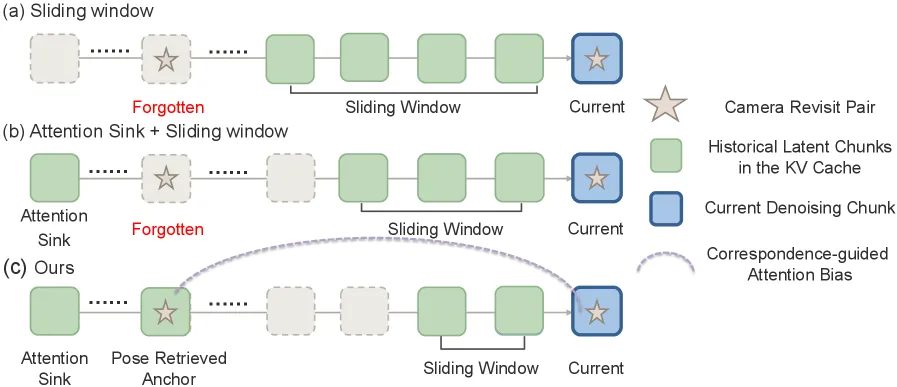
二、核心思想
问题定义
在交互式游戏或虚拟环境中,相机持续运动穿过大场景,离开某个区域后又可能在很晚的时间重新访问该区域。自回归视频生成模型以chunk为单位逐帧生成,并使用bounded KV cache来存储先前生成的latent chunks。当相机再次访问之前生成的位置时,如果该位置的对应chunk已经从干净的KV cache中被驱逐(evicted),模型将无法”回忆起”之前生成过的外观——即使条件渲染(如depth map)仍然与底层几何完美对齐,但重新生成的内容会与之前的版本不一致,导致视觉上的闪烁或不连续。这种failure模式称为revisit inconsistency。
现有工作在consistent video generation领域提出了多种方法:维护显式3D状态、geometric view memories、hierarchical latents,或learned context-querying和memory模块。但这些方法通常依赖于昂贵的人工标注长时序数据集以及额外的模型训练。本文提出的研究问题是:如何利用3D引擎本身已经提供的时空对应关系来提高 pretrained autoregressive 模型的 revisit consistency,而无需任何后训练?
解决方案概述
作者提出一种correspondence-guided memory framework,利用两个核心机制:
-
Temporal correspondence(时间对应):检索与当前chunk相机pose匹配的historical latent chunks,将它们作为loop-closure memory重新插入到clean KV cache中。这通过基于相似度的评分函数实现:同时考虑欧氏距离(位置接近)和角度余弦相似度(视角相近),并用场景规模归一化。
-
Spatial correspondence(空间对应):通过camera pose和depth reprojection,将token级的注意力偏移到检索到的chunk中与当前位置几何对应的区域。具体来说,使用重投影误差 B_s(p,k) 作为注意力偏置项,添加到标准注意力得分中:A_pk = q_p^T k_k / sqrt(d) + λ·B_s(p,k)。此外,引入occlusion-aware visibility检查,只接受通过源深度可见性测试的对应关系。
这种方法的关键特点是:training-free——它不修改预训练模型权重,也不进行额外训练;只利用推理时的条件和缓存机制。
关键设计决策
- 无训练干预: 所有改进均在推理阶段完成,不修改预训练参数
- 双管齐下: 同时解决 pose-level retrieval(记忆召回)和 token-level alignment(特征对齐)两个层次的问题
- 兼容现有架构: 可直接套用在任意基于self-attention和KV cache的autoregressive生成模型上
- 保持质量: 在提升一致性的同时不牺牲整体视频质量
三、技术架构
整体框架
该框架建立在Causal Wan-VACE(深度条件化的Wan文本到视频扩散模型)之上,包含三个主要组件:
| 组件 | 功能 |
|---|---|
| Pose similarity scoring | 根据相机位置和方向计算候选历史chunk的相似度分数 |
| Loop-closure retrieval | 选择最相似且满足约束条件的chunk reinstating到cache |
| Geometry-guided attention bias | 通过重投影计算attention偏置,引导关注几何对应区域 |
核心公式
1. Pose Similarity Score (Eq. 1)
为了找到与当前最相似的旧pose,定义scene-scale normalized pose similarity score:
其中 表示camera center, 表示 viewing direction, 是scene-scale normalizer, 是angular difference的加权项(文中取0.5)。
2. Admissible Set (Eq. 2)
满足以下条件的历史chunk进入候选集合 :
三个约束分别控制:
- 最大距离阈值 (场景尺度归一化后的欧氏距离)
- 最小角度余弦相似度 (视角接近程度)
- 最小时间间隔 (避免选择太近的重复chunk)
3. Geometric Correspondence Bias (Eq. 3)
对于query token 在当前frame 和key token 在retrieved frame 之间的attention偏置:
其中 是最终attention score, 是基于重投影误差的负向偏置(越小的偏差产生越大的偏置值), 控制偏置强度。
4. Reprojection Warp (Eq. 4)
计算query点 在source frame中的重投影坐标:
其中 是来自当前帧深度的平面度量深度, 是当前相机位姿(rotation + translation), 是当前内参矩阵, 是齐次坐标下的2D图像点, 是projection operator。
5. Occlusion-Aware Visibility Check (Eq. 5)
确保对应点在source视图中可见(未被遮挡):
即检查源帧的深度值是否大于重投影点的深度(不超过比例因子 ),如果是则认为该对应关系可见有效,否则排除(防止disappearance导致的前景错误引用)。
Cache Layout Design
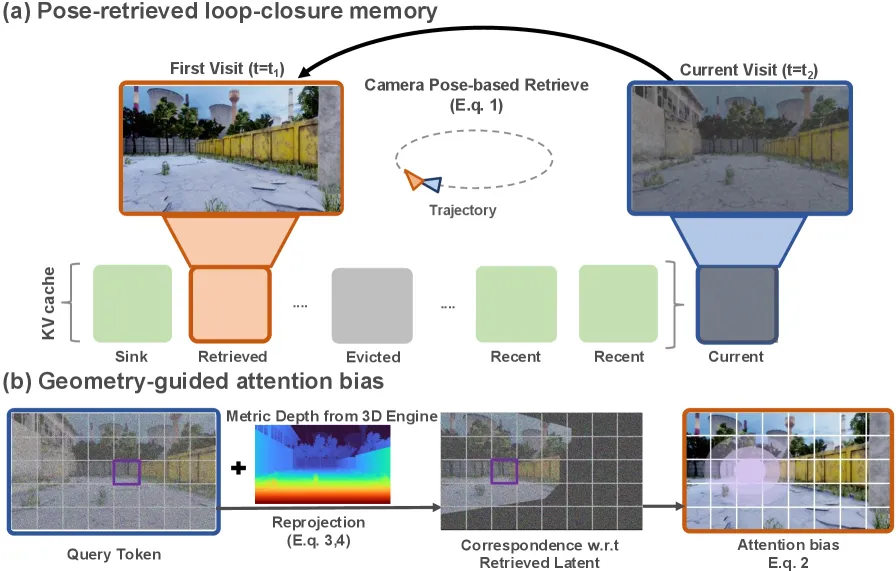
文章Figure 3(a)展示了三槽式clean cache布局:
- Anchor slot: 固定保留第一个chunk(persistent anchor)
- Retrieved slot: 存放通过pose retrieval选择的historical chunk
- Recent window: 存放最新生成的chunks(最近窗口)
具体参数:总预算 帧,anchor占用 帧,retrieved占用 帧,recent window占用 帧。
Cross-Branch Alignment
Causal Wan-VACE拥有main branch和control branch两个独立的cache。retrieved chunk需要同时注入到两个分支的对应RoPE位置,确保两分支对相同历史信息的感知一致。
四、核心创新
| 创新点 | 说明 | 理论/实验依据 |
|---|---|---|
| Training-free revisit consistency | 完全无需微调或后训练,仅靠推理时的缓存操作和attention偏置即可解决重访不一致 | 消融实验证明在不引入新参数的情况下显著提升一致性指标 |
| Pose-retrieved loop-closure memory | 利用相机姿态相似度从历史缓存中召回失忆的历史片段,类似SLAM中的loop closure detection | 量化结果显示PR组件对重访一致性的提升最大(Table 3) |
| Geometry-guided attention prior | 通过3D重投影计算attention空间偏置,使self-attention自然地关注几何对应区域,而不直接篡改已缓存的特征 | ablation显示GB在PR基础上进一步提升质量,保持无修改特性 |
| Occlusion-aware correspondence | 引入深度可见性检查,防止将错误的前景对应到背景的disappearance区域,避免结构重复 | 定性结果展示该方法有效避免了ghost artifacts |
| Cross-branch cache synchronization | 在multi-branch模型(如Wan-VACE)中协调不同分支的记忆恢复,保证多模态输出的协同一致性 | 实际应用于Depth-conditioned DiT架构 |
五、代码实现分析
基于项目主页信息,代码实现应包含以下关键组件:
ClosetheLoop/
├── model/
│   ├── causal_wan_vace.py          # Base model wrapper
│   └── self_forcing.py             # Self-forcing baseline
├── memory/
│   ├── pose_retriever.py           # Pose similarity & candidate selection
│   └── cache_manager.py            # Three-slot cache management
├── attention/
│   └── geometric_bias.py           # Reprojection-based attention prior
├── evaluate/
│   ├── tartan_ground.py            # TartanGround benchmark loader
│   └── tartan_air.py               # TartanAir benchmark loader
├── utils/
│   ├── metrics.py                  # L1, DINO, FID, LPIPS calculation
│   └── depth_encoder.py            # Depth preprocessing utilities
└── demo/
    └── example_usage.ipynb         # Usage examples
Key implementation details:
- No backward pass during inference — all operations are feed-forward
- Pose similarity computed on CPU/GPU before attention computation
- Reprojection warp uses provided intrinsics and extrinsic poses from the engine
- Attention bias is added directly to the attention mask before softmax
- Cache slot assignment is deterministic based on pose ranking
六、实验结果
Evaluation Setup
Evaluation datasets
-
TartanGround (Patel et al., 2025): Large-scale photorealistic Unreal Engine dataset built for ground-robot perception and navigation. Navigation trajectories naturally leave and return to places, engine supplies exactly camera pose and metric depth annotations assumed in the method.
-
TartanAir (Wang et al., 2020): Aerial drone navigation dataset with similar loop-closure properties, providing both synthetic and real-world-like sequences.
Evaluation metrics
-
Consistency metrics: Following MilliVid protocol, each loop pair’s two generated frames are compared using:
- L1 error (lower is better)
- DINOv2 cosine similarity (higher is better)
- Macro-averaged over each clip’s genuine loop-closure revisit pairs
-
Quality metrics: Perceptual quality of overall video (maintained without degradation):
- FID ↓ (Fréchet Inception Distance)
- LPIPS ↓ (Learned Perceptual Image Patch Similarity)
Baseline Methods
All methods share the same Causal Wan-VACE base model, depth control, prompts, random seeds, and KV cache size. Compared against:
- Self-forcing (SF): Base model with plain rolling window cache (no memory)
- + AS: With attention sink only — stabilizes global appearance but doesn’t address revisit specifically
- + PR: With pose-retrieved loop-closure memory — adds loop closure capability
- Ours (+AS+PR+GB): Full proposed method combining all three components
Quantitative Results
Table 1: Loop-closure consistency and overall video quality on TartanGround benchmark
Consistency metrics are macro-averaged over each clip’s genuine loop-closure revisit pairs; quality metrics measure overall perceptual fidelity. Every training-free cache-management scheme improves revisit consistency over the base model, confirming that memory management is the right lever for this problem. The full method pushes further by selecting memory with camera pose similarity and steering attention with geometry.
Table 2: Loop-closure consistency and overall video quality on TartanAir revisit benchmark
Similar conclusions: pose retrieval brings the dominant revisit-specific improvement, while geometry bias further refines consistency without compromising overall video quality.
Table 3: Component ablation on both benchmarks
Each row adds one component to the base student distilled with Self-Forcing (SF):
- AS (Attention Sink): Yields large gain by stabilizing global appearance against drift
- PR (Pose Retrieval): Dominant revisit-specific factor — access to the actual earlier view is what loop closure requires
- GB (Geometry Bias): Further refines attention guidance, improving consistency on top of PR
Qualitative Results
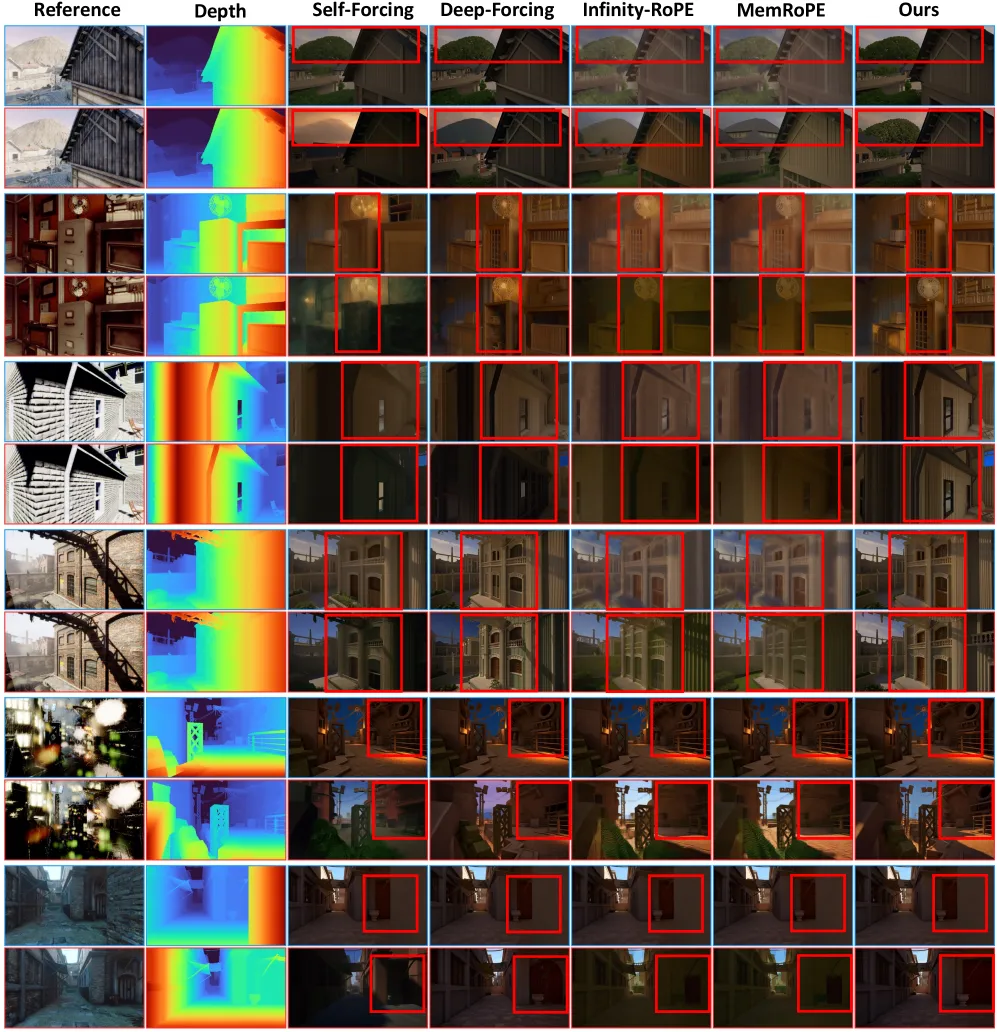 Figure 4 shows qualitative comparison on loop-closure revisits. Each pair of rows shows the first visit (blue) and the return (red) of one clip; the Reference and Depth columns show conditioning sources. Our method re-renders the same structures on return, while baselines alter structures or produce ghost artifacts.
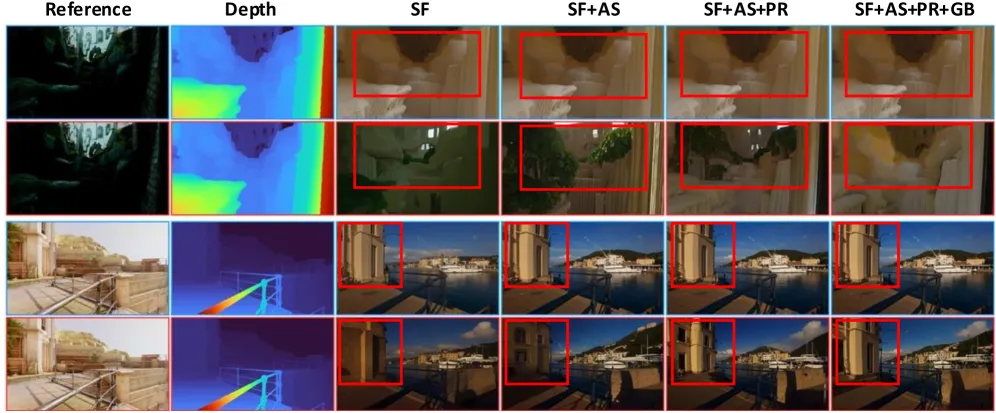 Figure 5 shows qualitative ablation: columns cumulatively add our components to Self-Forcing (SF): attention sink (AS), pose-retrieved memory (PR), and geometry-guided attention bias (GB). Rows pair first visit (blue) and return (red). Progressive addition demonstrates how each component contributes.
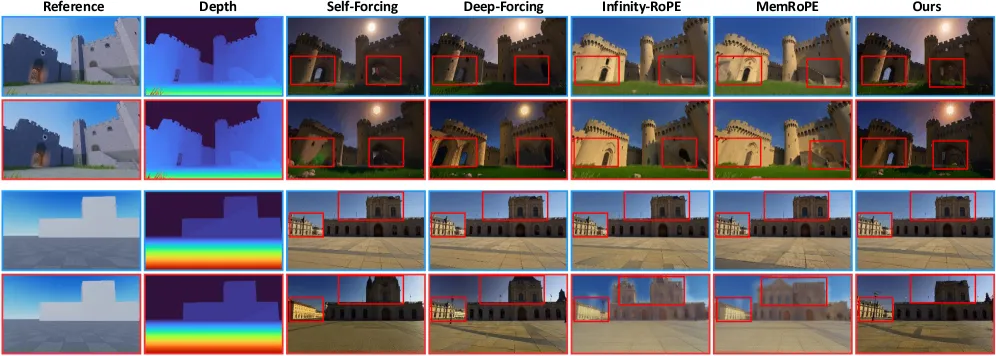 Figure 6 shows integration with an in-house game engine that streams exactly the annotations assumed in the paper: camera poses and metric depth directly to the generator. Two representative cases: a castle with complex architecture (top) and a scene built from texture atlas (bottom). On return, baselines alter structures; ours re-renders the same structures consistently.
七、相关工作
Generative Rendering
Generative rendering aims to lift low-fidelity yet precisely controllable outputs from 3D engines into realistic visual content. Given engine-provided conditions such as depth maps, untextured geometry, semantic buffers, or coarse simulations, a generative model can synthesize photorealistic images while preserving the controllability of the underlying graphics pipeline. This capability is especially attractive for gaming, virtual production, simulation, and immersive content creation.
Prior works include Wang et al. (2018a), Mallya et al. (2020), Cai et al. (2024), Gomez-Nogales et al. (2026), Cohen-Bar et al. (2026), Abu Alhaija et al. (2025), NVIDIA (2025), Jiang et al. (2025), fal.ai and Lightricks (2026). These explore combining 3D or simulator-derived conditions with image- or video-generation models including conditional GANs and diffusion models.
Consistent Video Generation
Long-term consistency has been studied in video world models through explicit memory, retrieval, and compact historical state. Relevant approaches include:
- Seoul World Model (Seo et al., 2026): Grounds world simulation in a real metropolis by retrieving relevant street-view context from a large database
- VMem (Li et al., 2025): Uses memory network to remember past frames
- Memorize-and-Generate (Zhu et al., 2025): Trains a memory block to compress historical information for real-time generation
- MotionStream (Shin et al., 2025): Combines self-forcing (baseline) with a memory block for long consistent video
- World Simulator / Gemini World: Uses 3D as long-term grounding for memory
These approaches typically require additional training on curated long-horizon datasets or extra model components.
Autoregressive Video Generation
Current autoregressive video diffusion models generate long videos in latent chunks: a causal generator denoises the current chunk while attending to a fixed-size sliding window of previously generated chunks through a key-value (KV) cache, keeping memory and per-chunk compute constant as the video grows. Prior work on inference-time memory includes AR-Chameleon and MemoryDream, which use retrieval-based memory mechanisms.
The key distinction of this work is its focus on the generative rendering setting where precise 3D conditions (poses, depth) are available from the engine, enabling geometry-aware retrieval and attention that generic video world models cannot exploit.
八、总结
核心贡献
- 提出了一种training-free的 revisit consistency解决方案,适用于长序列自回归生成渲染
- 设计了pose-retrieved loop-closure memory机制,从KV cache中召回因上下文蒸发而丢失的历史片段
- 引入了geometric correspondence as attention prior,通过3D重投影bias引导attention聚焦于几何对应区域
- 在TartanAir和TartanGround数据集上构建的loop-closure benchmark上实现了state-of-the-art的重访一致性表现
- 验证了方法在实际游戏引擎中的集成能力,保持原有视频质量的同时显著提升一致性
技术影响
- 为自动驾驶模拟、虚拟制片、游戏开发等需要长时间一致性的应用场景提供轻量级解决方案
- 证明了利用3D引擎已有输出(pose + depth)而非依赖额外训练的价值
- 提供了一种通用的”memory replay”思路:通过精确的空间-时空对应解决上下文丢失导致的重访不一致问题
局限性
- 高度依赖3D引擎提供准确的camera poses和metric depth;如果这些条件存在噪声或不准确,性能可能下降
- 假设场景是静态或缓慢运动的,不适用于场景中有快速移动物体的动态环境
- 当前的三槽式cache管理策略可能不是最优的;未来可探索更智能的替换策略和内容感知的内存管理
未来方向
- 扩展到其他类型的条件输入,如semantic layouts、point clouds、neural radiance fields等
- 学习更适合非刚性运动的变形对应关系,处理场景中存在moving objects的情况
- 探索将部分记忆机制蒸馏回模型本身的可行性,形成端到端的可训练方案
- 应用于更长的视频序列和更大规模的开放场景
九、参考资源
| 类型 | 链接 |
|---|---|
| arXiv论文 | https://arxiv.org/abs/2607.21848 |
| 项目主页 | https://wenchao-m.github.io/ClosetheLoop.github.io/ |
| TartanAir数据集 | https://xiaolinlin.com/tartanair/ |
| TartanGround数据集 | Patel et al. (2025) |
| Wan-VACE论文 | Jiang et al., 2025 |
| MilliVid评估协议 | Chandratreya et al., 2026 |
| DINOv2特征提取 | Oquab et al., 2024 |
引用
@article{ma2026closing,
  title={Closing the Loop: Training-Free Revisit Consistency for Autoregressive Generative Rendering},
  author={Ma, Wenchao and Liu, Changran and Huang, Sharon X. and Jiang, Haomiao},
  journal={arXiv preprint arXiv:2607.21848},
  year={2026}
}
Analysis generated using paper-analyzer skill based on arXiv HTML version v1. Figures sourced from arXiv HTML (x1.png through x6.png), renamed to descriptive kebab-case filenames.