ACTA: Automatic Configuration of the Tensor Memory Accelerator for High-End GPUs
A software library that heuristically determines optimal tile sizes and queue configurations for TMA-based GPU kernels using the GPU Specification Table (GST) and Little's Law
ACTA: Automatic Configuration of the Tensor Memory Accelerator for High-End GPUs
一、论文概述
| 项目 | 内容 |
|---|---|
| 标题 | ACTA: Automatic Configuration of the Tensor Memory Accelerator for High-End GPUs |
| 作者 | Nicolás Meseguer, Yifan Sun, José L. Abellán, Michael Pellauer, Manuel E. Acacio |
| 机构 | Universidad de Murcia (Spain), William & Mary (USA), NVIDIA (Boston, USA) |
| 论文 | https://doi.org/10.1145/3725798.3725802 |
| 代码 | 未公开 |
| 发布 | GPGPU ‘25, March 01, 2025, Las Vegas, NV, USA |
| 许可 | CC-BY-4.0 |
二、核心思想
问题定义
现代高端GPU(如NVIDIA Hopper H100)引入了Tensor Memory Accelerator (TMA)硬件单元,用于异步全局内存到共享内存的数据传输,并与计算重叠以隐藏内存延迟。然而,TMA的配置极其复杂:程序员必须手动确定tile size、queue slots数量、内存步幅等参数。配置空间随队列数量指数增长(例如Matrix-Matrix核可达 2.6×10¹⁴种组合),穷举调优不切实际。
ACTA的核心洞察是:通过GPU Specification Table (GST)获取硬件参数,结合算术强度(arithmetic intensity)和Little’s Law,可以启发式地推断出接近最优的tile size和queue slots配置。
解决方案概述
ACTA是一个软件库,提供主机端API,在kernel launch之前自动计算TMA OperandQueues的最优配置。其工作流程:
- 从GST读取硬件规格(SM数量、时钟频率、共享内存大小、带宽、延迟等)
- 接收kernel的算法特征(算术强度、consumer wavefront数量、compute units)
- 对每个注册的queue,自动计算最优tile size和slot数量
- 返回配置参数供kernel launch使用
三、技术架构
GPU Specification Table (GST)
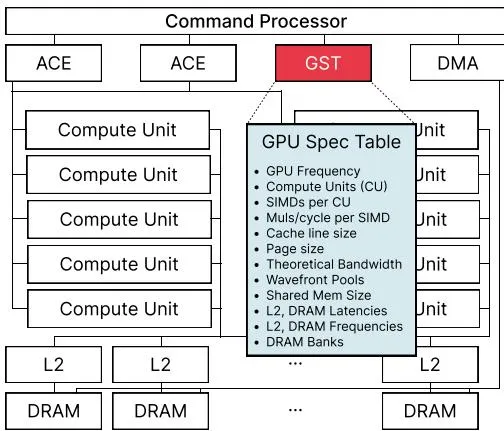
GST是ACTA引入的新硬件结构(图1中标红),位于Command Processor之后,提供以下关键参数:
| 参数类别 | 具体字段 |
|---|---|
| 计算能力 | SM数量、时钟频率、SIMD/Muls per cycle |
| 缓存层次 | L1 Vector Cache大小/关联度、L1 Inst Cache、L1 Scalar Cache、L2 Cache大小/关联度 |
| 内存 | DRAM容量、峰值带宽 |
| 共享内存 | 可用LDS/Shared Memory总量 |
ACTA工作流程
Host Side:                          GPU Hardware:
────────────                         ─────────────
1. MemCopyH2D(A, B)       ──►   GST (Query hardware params)
2. CreateCommandQueue()
3. InitACTA(ArI=MEDIUM,    ──►
              WFs=8, CUs=64)
4. RegisterQueue(K, 4, TYPE_STREAMING)
5. RegisterQueue(K, 4, TYPE_STATIONARY)
6. SizeQueue()              ──►   optimal_tile_size() + optimal_num_slots()
7. SizeQueue()
8. EnqueueLaunchKernel()    ──►   Kernel launched with ACTA-configured args
核心算法
算法1:最优Tile Size计算 (optimal_tile_size)
对每个候选tile size(范围[min=64, max=8192]元素),计算:
Merit Factor(处理时间与内存传输时间的比值):
其中:
处理时间计算 (Algorithm 2):
内存传输时间计算:
最终选择使加权merit score最优的tile size,并根据算术强度调整:
- 低Ar.I.核(Elementwise/Dot-Product):增大tile size以提高内存吞吐
- 高Ar.I.核(Matrix-Matrix):减小tile size以平衡内存与计算重叠
算法2:最优Slot数量计算 (optimal_num_slots)
Streaming队列 — 使用Little’s Law: 其中N是队列中的平均项目数(slots),λ是tile加载速率,T是单个tile的处理时间。
具体步骤:
- 用Little’s Law计算理想slot数
- 向上/下取整到最近的2的幂
- 根据compute units数量调整
- 验证是否适合可用共享内存
Stationary队列 — 基于算术强度:
- 计算剩余共享内存
- 按队列数量均分
- 确定可容纳的slot数量
- 同样取2的幂并调整
OperandQueues抽象
ACTA使用自定义OperandQueues(受Bufets [17]启发)管理TMA操作:
- Producer warp:使用queue传输数据,通过queue函数同步
- Consumer warps:从queue获取数据并处理,消费后通知queue加载下一tile
- 两种queue类型:TYPE_STREAMING(tile尺寸变化)和TYPE_STATIONARY(tile尺寸固定)
四、核心创新
| 创新点 | 说明 | 理论/实验依据 |
|---|---|---|
| GST硬件表 | 引入新的硬件结构存储GPU规格参数,供ACTA查询 | 图1所示架构;使ACTA跨架构适用 |
| 基于Little’s Law的队列配置 | 首次将排队论应用于TMA queue slots分配 | 理论保证流均衡,避免内存压力 |
| Merit Factor启发式 | 结合处理/内存效率比和成本函数选择tile size | 算法1+2,单遍配置达到穷举的97.22%性能 |
| 双队列类型区分 | Streaming和Stationary队列分别采用不同分配策略 | Streaming优先,Stationary使用剩余空间 |
五、实验结果
基准测试
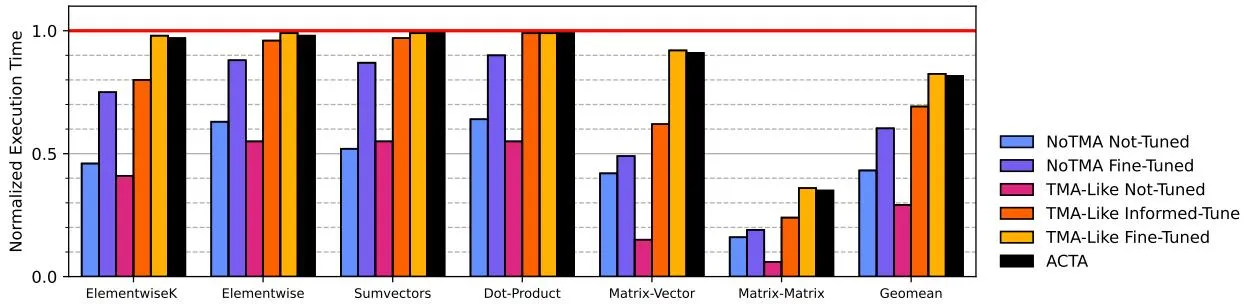
评估了6种执行方案 across 5个linear algebra kernels:
| Kernel | 维度 | #Queues | 设计空间大小 |
|---|---|---|---|
| ElementwiseK | 16,777,216 | 1 | 25 |
| Elementwise | 16,777,216 | 2 | 625 |
| Sumvectors | 16,777,216 | 2 | 625 |
| Dot-Product | 2,097,152 | 2 | 625 |
| Matrix-Vector | [2048,2048]×2048 | 8+1 | 2.6×10¹⁴ |
| Matrix-Matrix | [512,2048]×[2048,128] | 8+1 | 2.6×10¹⁴ |
6种执行方案对比(性能归一化到”Speed of Light”理想TMA上限):
- Naive Kernel - Untuned:无TMA,无调优 → 最差
- Naive Kernel - Exhaustive:无TMA,穷举调优 → 简单核表现好,复杂核受限
- No TMA - Naive Config:有TMA但配置不当 → 性能差
- No TMA - NVIDIA Heuristic:有TMA但用启发式固定配置 → 简单核有效,复杂核不足
- No TMA - Exhaustive Tuning:穷举搜索最优配置 → 最佳但需2.6×10¹⁴次kernel launch
- ACTA:单次launch,自动配置 → 性能达到穷举的97.22%(within 2.78%)
关键结果:
- ElementwiseK/Elementwise/Sumvectors/Dot-Product:ACTA性能达到最优的99%以上(within 1%)
- Matrix-Vector:ACTA达到理想性能的90%+
- Matrix-Matrix:ACTA达到理想性能的35%+(受限于shared memory中数据重用最小)
- 相比NVIDIA启发式配置(tile 64-256, slots 2-4),ACTA在复杂核上显著优于固定启发式
消融实验
ACTA通过对比不同配置策略(untuned/heuristic/exhaustive/ACTA)间接进行了消融,证明:
- 自动配置远优于无TMA(即使穷举调优)
- 自动配置显著优于NVIDIA启发式固定配置
- 自动配置接近穷举调优(仅差2.78%),但只需一次kernel launch
六、相关工作
| 工作 | 关系 |
|---|---|
| Singe (PPoPP’14) [1] | Warp specialization编译器,ACTA继承其producer-consumer范式 |
| Bufets (ASPLOS’19) [17] | 显式解耦数据编排idiom,ACTA的OperandQueues受其启发 |
| WASP (HPCA’24) [4] | 硬件加速自动warp specialization,与TMA互补 |
| CudaDMA (SC’11) | Bauer等人的早期工作,2-way warp specialization |
| NVIDIA Hopper TMA [3, 12] | ACTA针对的硬件目标 |
七、总结
核心贡献
- ACTA库:首次实现TMA配置的自动化,通过GST+Little’s Law启发式算法消除手动调优需求
- GST硬件结构:提出GPU Specification Table作为硬件抽象层,使配置跨架构可移植
- 接近最优的单遍配置:仅需一次kernel launch即达到穷举调优的97.22%性能
- 简化开发流程:开发者只需调用InitACTA/RegisterQueue/SizeQueue三个API即可配置TMA
局限性
- 当前仅在AMD R9 Nano + 模拟TMA上评估(TMA-Like),尚未在真实Hopper GPU上验证
- Matrix-Matrix核的性能瓶颈在于shared memory重用率极低,这是架构限制而非ACTA算法问题
- 未来需在多款GPU架构上验证可移植性
技术影响
ACTA代表了GPU编程模型的重要转变:从”程序员手动调优”到”硬件信息+启发式算法自动配置”。随着TMA成为高端GPU的标准特性(Hopper及后续架构),类似ACTA的自动配置工具将大幅降低GPU编程门槛,同时保持高性能。
八、参考资源
- 论文DOI: https://doi.org/10.1145/3725798.3725802
- GPGPU ‘25: 17th Workshop on General Purpose Processing Using GPU, Las Vegas, NV, USA
- MGPUSim: https://github.com/mgpusim/mgpusim (模拟环境)
- Bufets论文: Pellauer et al., ASPLOS ‘19, “An Efficient and Composable Storage Idiom for Explicit Decoupled Data Orchestration”
- WASP论文: Crago et al., HPCA ‘24, “Exploiting GPU Pipeline Parallelism with Hardware-Accelerated Automatic Warp Specialization”