Kimi K3: Open Frontier Intelligence
2.8T 参数原生多模态 MoE、104B 激活参数、1M token 上下文、Kimi Delta Attention + Attention Residuals + Stable LatentMoE 的开源前沿模型
Kimi K3: Open Frontier Intelligence
一、论文概述
| 项目 | 内容 |
|---|---|
| 标题 | Kimi K3: Open Frontier Intelligence (Technical Report of Kimi K3) |
| 作者 | Kimi Team (Moonshot AI,Tongtong Bai 等 400+ 位署名作者) |
| 机构 | Moonshot AI(月之暗面) |
| 论文 | arXiv:2607.24653 · PDF |
| 代码 | MoonshotAI/MoonEP · FlashKDA · MiniTriton · nano-kpu · AgentENV |
| 模型页 | Kimi K3 Blog |
| 发布 | 2026-07-27 (arXiv v1) |
| 类别 | cs.CL (Computation and Language) |
| 许可 | 开源权重(Open Frontier Model) |
二、核心思想
Kimi K3 是一款 2.8 万亿总参数、104B 激活参数、原生多模态、100 万 token 上下文 的开源 Mixture-of-Experts (MoE) 模型。它是继 Kimi K2 (1.04T) 和 Kimi K2.5 后 Moonshot AI 发布的旗舰模型,也是世界首个开源的 3T 类别模型。
论文将 LLM 发展的两个扩展轴同时推向前沿:
- 训练时扩展 (第一轴):把预训练底座扩展到 3T 类参数规模;
- 测试时扩展 (第二轴):跨 general / agentic / coding 三大领域,在多个 reasoning-effort 层级上进行强化学习,实现 1M 上下文的长视野交互。
问题定义
开源模型生态在推理与 agentic RL 层面推进迅速,但基础模型规模长期停留在 1T 级别 [MiMo-V2.5-Pro / Inkling 等]。当越来越复杂的推理与 RL 方法作用于相近规模的底座时,开源进度会趋同,而与最强专有模型 (Claude Fable 5、GPT-5.6 Sol) 的差距会持续拉大。作者试图通过同时在两个轴上扩展填补这一鸿沟。
具体挑战:
- 在 3T 类规模下如何保证训练稳定性与效率;
- 如何在深度、序列长度、通道三个维度同时高效扩展信息流;
- 如何设计能扩展到 1M 上下文和上千步工具调用的 agentic RL;
- 如何在架构复杂性 + 极稀疏 MoE + 百万 token trajectory 下同时兼顾训练与推理成本。
解决方案概述
- 架构层:Hybrid Attention(3 层 KDA + 1 层 Gated MLA)、Attention Residuals(AttnRes,跨深度选择性检索)、Stable LatentMoE(896 routed × 16 active × 2 shared experts,稀疏度 56)、原生多模态 MoonViT-V2、Per-Head Muon 优化器。
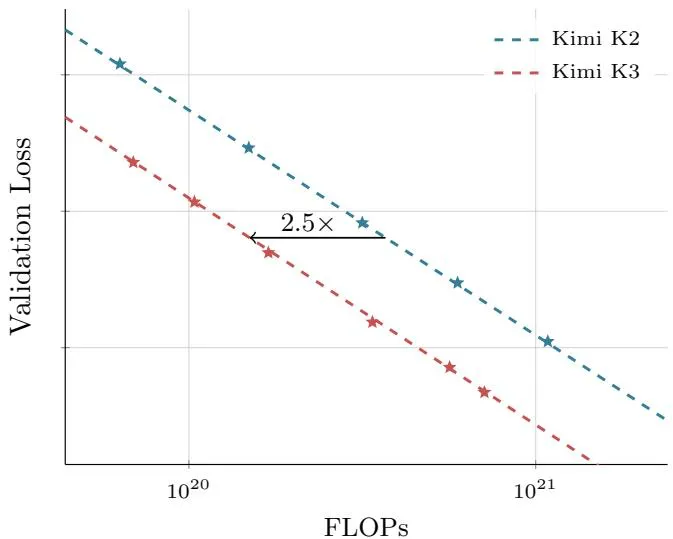
- 训练层:Cosine LR、Weight Clipping、QAT (MXFP4 权重 / MXFP8 激活)、四阶段渐进式上下文扩展 (8K → 64K → 256K → 1M);相比 Kimi K2 实现 ~2.5× 的整体 scaling efficiency 提升。
- 后训练层:SFT → 三领域 × 三 effort 级 (9 位专家) RL → Multi-Teacher On-Policy Distillation (MOPD);引入 Agentic Generative Reward Model 与 Reasoning-Effort RL。
- 基础设施:FlashKDA + KDA Context Parallelism、MoonEP(完美负载均衡 EP)、External KV Cache Pool + AgentENV microVM sandbox、KDA-aware Prefix Cache、Speculative Decoding + EAGLE-3 draft。
三、技术架构
整体框架
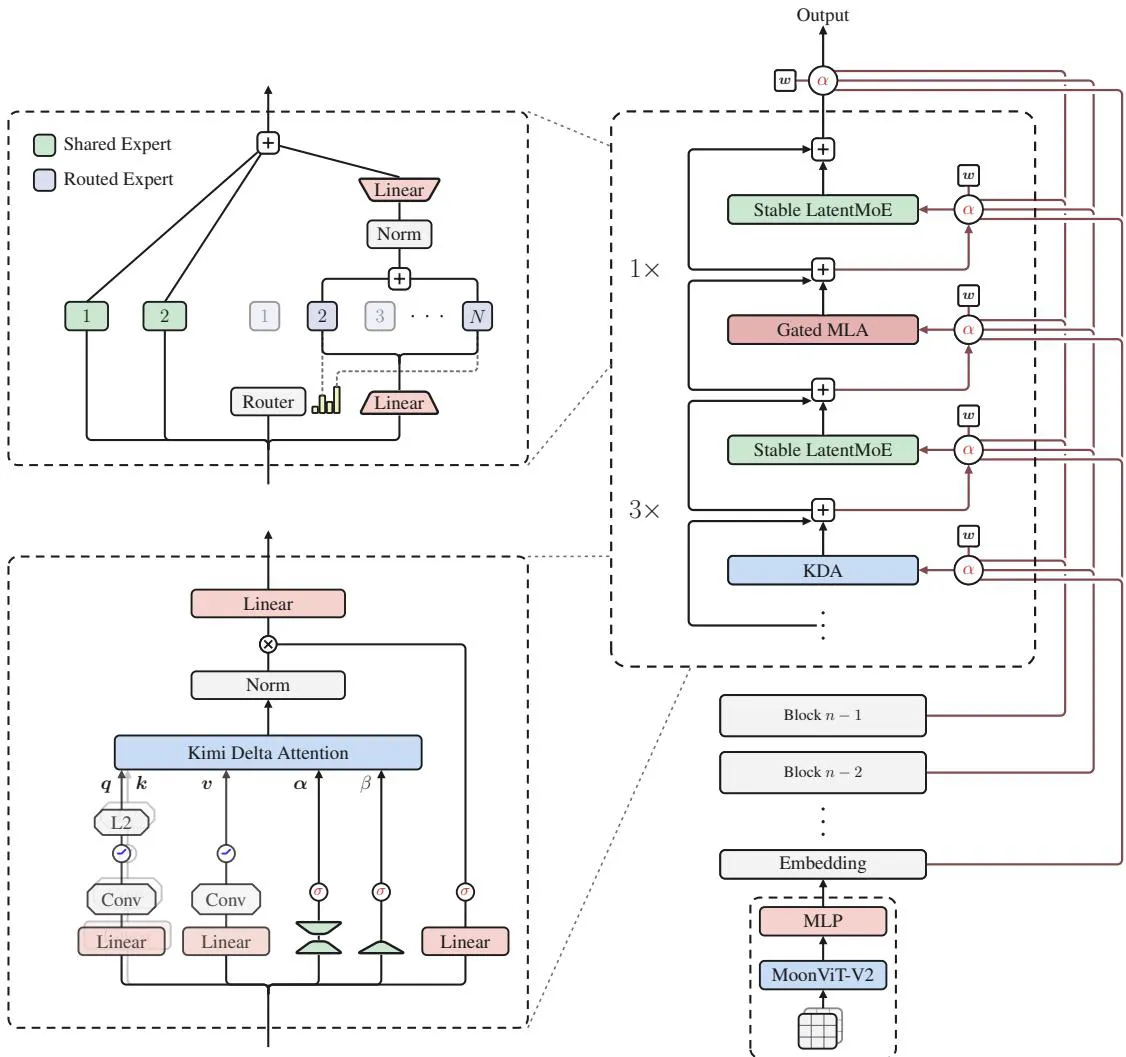
Kimi K3 沿三个互补维度扩展信息流:序列 (Hybrid Attention) × 深度 (AttnRes) × 宽度 (Stable LatentMoE)。每个 Block 由 3 层 KDA + 1 层 Gated MLA 组成,每层 attention 后接 Stable LatentMoE。骨干最后额外追加 1 层 Gated MLA,确保最终层始终执行全局注意力。原生视觉通过 MoonViT-V2 + 轻量 MLP projector 注入共享 embedding。
Input (text + image + video)
        │
        ▼
   MoonViT-V2 (27 layers, 401M params) + MLP Projector    ─────┐
        │                                                       │
        ▼                                                       │
   Embedding Layer                                              │
        │                                                       │
        ▼                                                       │
   ┌────────────── Block (× N) ──────────────┐   AttnRes (Block-level,
   │ 3× (KDA + Stable LatentMoE)             │◄──── N=8 blocks with
   │ 1× (Gated MLA + Stable LatentMoE)       │      12 layers each)
   └─────────────────────────────────────────┘
        │
        ▼
   Final Gated MLA (guarantee global attention)
        │
        ▼
   MTP Layer (1 layer, EAGLE-3 style draft during inference)
        │
        ▼
   LM Head
Block 组成比例:61 MLA (K2) → 69 KDA + 24 MLA (K3),即 93 层中 3:1 交替,附加 1 层最终 MLA。
核心公式
1. Kimi Delta Attention (KDA) 递推
在 delta-rule 递推基础上引入通道级遗忘门 与写强度 ,隐状态 :
Per-head 参数化(对每个 head ):
2. Chunkwise 并行形式
将序列分为大小 的 chunk,在 chunk 内并行、chunk 间递推。定义累积衰减 ,:
UT-transform 生成 ,pseudo-value ,chunk 内全部输出并行计算:
3. Lower-bounded Log-Decay(Kimi K3 关键变化)
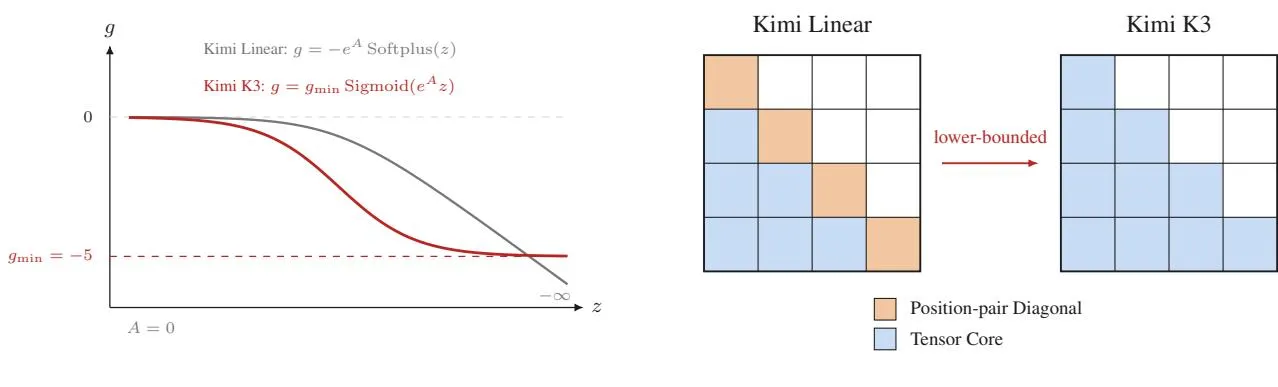
Kimi Linear 使用 ,可能溢出 BF16。Kimi K3 改用 scaled sigmoid,将 log-decay 有下界:
保证 16-token tile 上 cumulative log-decay ,倒数 rescaling 上界 ,落在 BF16 范围内;所有对角与非对角 tile 都可用 dense Tensor Core matmul,消除 position-pair 对角瓶颈。参见 Figure 3。
4. KDA Full-Rank Output Gate
将 Kimi Linear 的低秩输出门改为输入相关的全秩投影,先对 recurrent 输出做 head-wise RMSNorm,再门控:
5. Gated MLA (NoPE) 输出门
所有 MLA 层采用 NoPE(无显式位置编码),全局内容交互,位置感由中间的 KDA 层提供。同样引入 full-rank channel-wise 门:
6. Full Attention Residuals (AttnRes)
对第 层设 pseudo-query ,keys/values 取自 embedding 与所有前层输出:
Softmax kernel ,注意力权重与聚合:
Full 形式代价为 算力 + 存储,其中 。
7. Block Attention Residuals
把 层划为 个 block,每块 层。块内求和为 ,块间做 full attention:
存储/通信开销由 降至 ,Kimi K3 取 、每块 12 层,加上 embedding 层共 9 个 block。
8. Stable LatentMoE 前向
设隐维 、latent 维 (),routed experts ,shared experts :
Kimi K3 固定 ,routed pool 896,(稀疏度 56)。RMSNorm 位于聚合后、上投影前,降低对 expert 组合缩放的敏感度。
9. Sigmoid Tanh Unit GLU (SiTU-GLU)
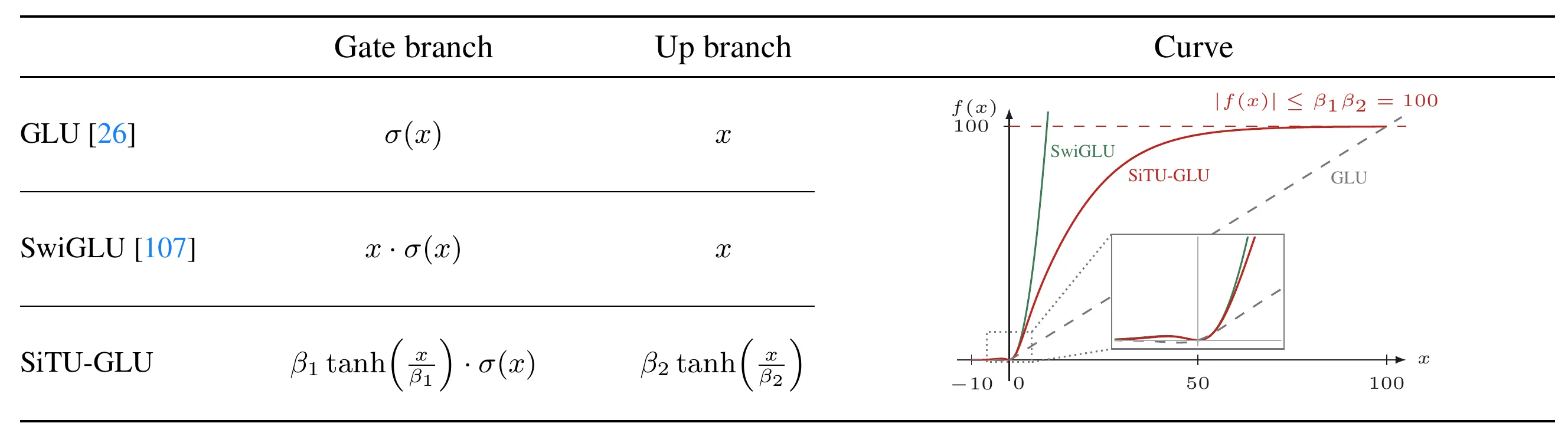
Kimi K3 使用 ,输出被界定为 ,同时在原点附近近似 SwiGLU,参见 Figure 4。
10. Quantile Balancing (QB) 路由
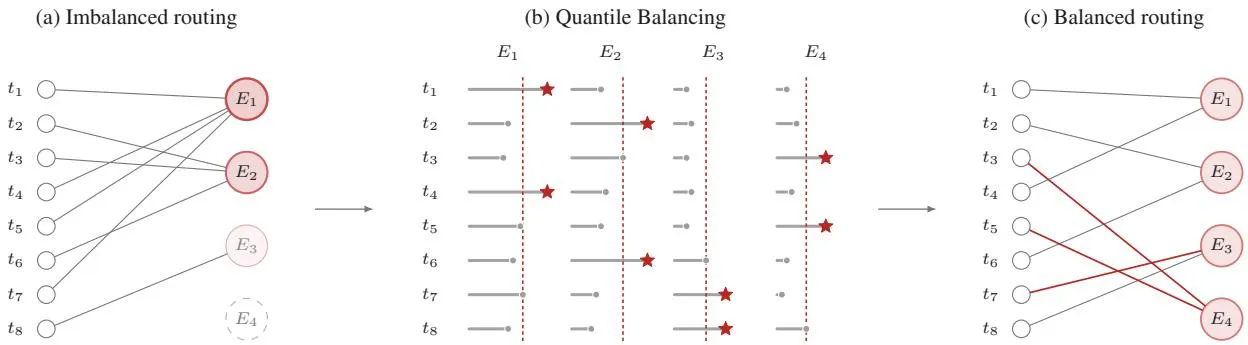
Router score ,附加 expert bias ,Top-k 选择用 biased score,pi 计算不含 bias:
对 batch 每个 expert 的 bias 由 margin 分位数一步给出:
其中 为 Top-(k+1) 路由取得的第 (k+1) 个 biased score。全局分位数使用直方图估计(每个 expert 数百 bin,all-reduce 累加),单次 batch 完成 update,next step 生效以保证因果性。
11. Multi-Teacher On-Policy Distillation (MOPD) 奖励
对领域 、reasoning effort ,从 9 个专家中选取 。给定 query 与 prefix ,per-token OPD reward:
其中 sg 为 stop-gradient, 裁剪防止极端 advantage 破坏训练稳定性。
12. Speculative Decoding: LK Loss(EAGLE-3 draft 训练目标)
推测采样接受率为 ( target, draft)。直接最小化 KL 不保证最大化接受率,改为最大化接受率的负对数:
Draft 输入为 target 模型第 1、4、最终 AttnRes block 的低/中/高层特征拼接,通过 bias-free 矩阵 投影(初始化为 ,训练中逐步引入低/中层特征)。
13. KDA Context Parallelism (KCP) 状态分解
KDA 递推 ()依赖前 state,无法用 局部计算后简单求和。KCP 将每段效果分解为两个可局部计算的量:
其中 为从 起算的局部状态;每 rank 只需交换 与 ,通过 fixed-size all-gather + prefix-scan 恢复所有 rank 的入 state,实现线性算力扩展。
模型组件
| 组件 | 说明 | 关键参数 / 数值 |
|---|---|---|
| Total / Activated | MoE 参数与激活 | 2.78 T / 104.2 B (K2: 1.04 T / 32.6 B,↑167% / ↑220%) |
| Layers | Transformer 层数 | 93 (K2: 61,↑52%) |
| Attention Composition | KDA + MLA hybrid | 69 KDA + 24 MLA + 1 final MLA |
| Hidden Dimension | 7,168 (K2 同) | |
| Latent MoE Dimension | 3,584 (0.5 × d) | |
| MoE Hidden per Expert | Routed FFN 隐维 | 3,072 (K2: 2,048,↑50%) |
| Routed Experts | 每层路由专家 | 896 (K2: 384,↑133%) |
| Active Experts / Token | 每 token 激活 | 16 (K2: 8,↑100%) |
| Shared Experts | 每层共享专家 | 2 (K2: 1,↑100%) |
| Attention Heads | Head 数量 | 96 (K2: 64,↑50%) |
| Dense Layers | 稠密层数 | 1 |
| Vocab Size | 词表 | 160 K |
| Training Context | 训练上下文 | 1 M tokens (K2: 128 K,↑8×) |
| Activation Function | GLU 变体 | SiTU-GLU (K2: SwiGLU) |
| Position Encoding | 位置编码 | NoPE(KDA 提供隐式位置) |
| MTP Layer | Multi-Token Prediction | 1 layer (EAGLE-3 draft) |
| ViT | MoonViT-V2 | 401 M params, 27 layers, patch 14, 12 heads, RMSNorm + no bias |
| Sparsity | routed / active | 896 / 16 = 56 |
| AttnRes | Block 划分 | 块 × 12 层 + embedding block(共 9) |
| Optimizer | Per-Head Muon + weight clipping | 每 head 独立 Newton–Schulz 正交化 |
| Quantization | QAT | MoE 权重 MXFP4 / 激活 MXFP8,其余高精度 |
| LR Schedule | 余弦衰减 + 1% linear warmup | Weight decay 0.1 |
| KV Cache | KDA 固定态 + MLA paged KV | Hybrid paged pool |
| Scaling Efficiency | vs K2 | ~2.5 × |
训练流程
Kimi K3 训练全流水线分为 预训练 → 长上下文 cooldown → SFT → RL → MOPD → QAT Draft:
-
Pre-Training Data:Web / Code / Math / Knowledge 四大文本域 + 大规模视觉语料(captions、interleaved 图文、OCR、感知、视频、visual coding SVG / 3D / Webpage / Game / CAD)。文本经过 rule + classifier + dedup 三重过滤,并按 K2 recipe 进行 rephrase(风格与视角多样化 + chunk-wise 自回归生成 + 与源文档保真度校验)。视觉坐标使用绝对与归一化 [0,1] 双格式。
-
Progressive Context Extension(四阶段):
- 预训练:8 K → 64 K
- Cooldown:256 K → 1 M
- 长文本 upsample + 跨文档拼接合成长依赖任务,避免退化为局部模式。
-
Scaling Law:重新调优 batch size、learning rate、TPP (tokens-per-parameter)、模型形状;cosine decay 在各自最优超参下始终优于 WSD;架构 + 数据 + 训练配方联合带来 ~2.5× scaling efficiency 提升(Figure 7)。
-
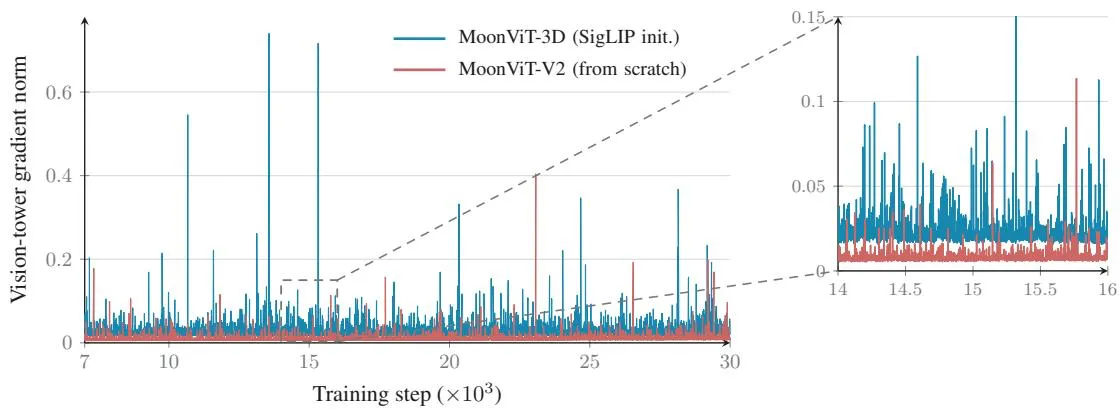
Native Multimodal Training:MoonViT-V2 从头训练,与文本共享 backbone、共享单一 next-token prediction 目标;相比 SigLIP-initialized MoonViT-3D 展现更低、更稳定的梯度范数(Figure 6)。
-
Post-Training 三阶段:
- SFT:使用 XTML (eXtensible Token Markup Language) chat template(附录 F)序列化 agentic trajectory;从 SFT 阶段起启用 QAT (MXFP4/MXFP8)。
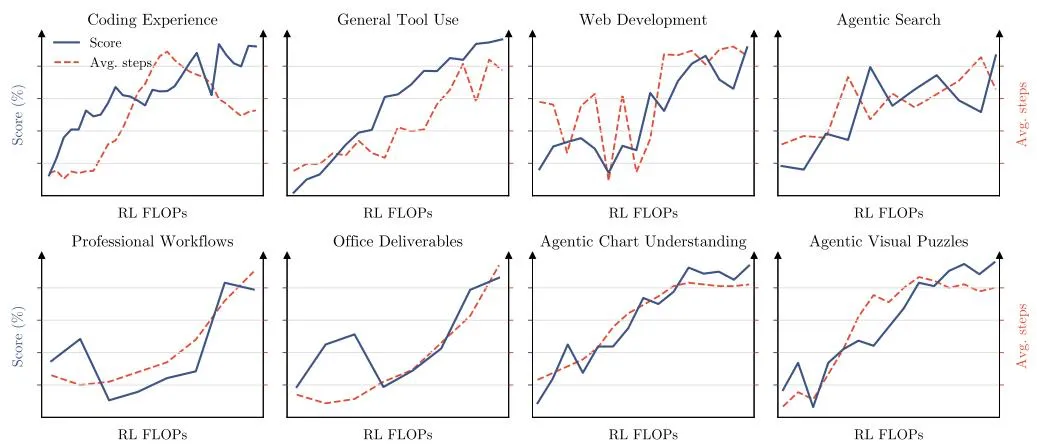
- RL:三领域 × 三 effort 级 = 9 位 domain × effort 专家。partial rollout(λ 分数完成即启动 policy update)+ per-token 正则处理 off-policy stale 数据;Reasoning-Effort RL 通过预算 + 乘子 与超时 reward = -1 逐步 anneal;non-verifiable 任务采用 Agentic Generative Reward Model (GRM) + verbosity budget( 超长即败)。
- MOPD:以 9 位专家为教师,per-token dense clipped reward(Eq. 15);实验中 top-k 蒸馏未见明显增益。
- QAT + Draft FT:MTP 层 fine-tune 为 EAGLE-3 draft,直接优化 LK loss(Eq. 16)。
-
RL 任务合成与环境:
- Unified White-Box RL Environment:将 agent harness 抽象为可组合模块(tools / system prompt / context mgr / skills / memories / subagents),可实例化 Kimi Code、Claude Code、Codex、OpenClaw、Hermes 等;训练时动态构造 harness 组合。
- Knowledge-Graph-Guided Task Synthesis:agent-driven DAG 递归扩展知识图谱,节点 keyword → web 检索 → 合成 coding/knowledge/vision 任务(Figure 9)。
- Verifiable Agentic Environments:多步搜索、投行 / 数据分析 / 法律 sandbox 工作流、Python 工具视觉推理(模型自主写代码 crop/zoom/verify)。
- Kernel Optimization Tasks:CUDA/Triton/CuTe/Gluon/ThunderKittens/TileLang,BF16/FP8/FP4;奖励 = 正确性 + performance vs. expert(0.5–1.0 to hardware roofline),带 hacking-detection(防 CUDA graph replay/input caching/精度作弊)。
- Personal Assistant Tasks:模拟 Gmail/Notion/Slack/Canvas 应用,多日持久环境,一次 rollout 可能 上千工具调用、上百万 context tokens。
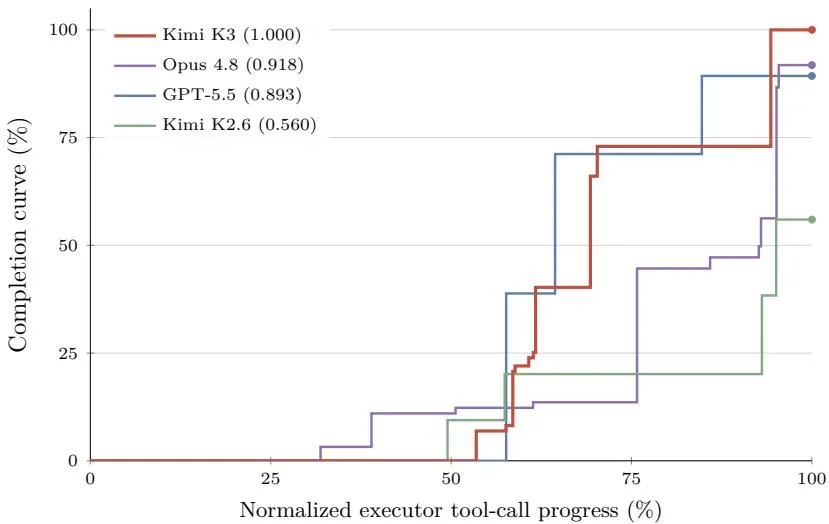
- Autonomous Execution Tasks (AET):黑箱系统复制(Figure 10)、量化因子发现、税务审计;hidden verifier + public diagnostic verifier 防作弊。
- Web Development Tasks:website / 游戏 / 3D / WebGL / SVG / 全栈应用;containerized sandbox + deterministic checks + model judging,构建失败或伪实现直接零分。
四、核心创新
| 创新点 | 说明 | 理论/实验依据 |
|---|---|---|
| Kimi Delta Attention (KDA) + 下界衰减 | delta-rule + channel-wise forget gate + scaled sigmoid 下界() | Eq. 1–6;对角 tile 可用 dense Tensor Core(Figure 3),显著加速长序列 mixing |
| Hybrid Attention 3:1 | 3 KDA + 1 Gated MLA + NoPE + 末层强制 MLA | 位置感由 KDA 提供,MLA 只做全局内容交互;context 扩展无需 RoPE 调频/YaRN |
| Attention Residuals (AttnRes) | pseudo-query 对所有前层输出做 softmax attention;Block AttnRes 将存储从 降到 | Eq. 8–10; 恢复 full AttnRes 大部分收益;online-softmax 与 TP all-reduce 融合 |
| Stable LatentMoE | Latent 维 + RMSNorm + SiTU-GLU + Quantile Balancing | Eq. 11–14;896 experts × 16 active,稀疏度 56;软 cap 有效防低精度溢出;QB 用一次直方图 all-reduce 完成全局分位数估计 |
| Per-Head Muon | Newton–Schulz 正交化按 head 拆分 momentum | 均衡 head 更新尺度、减少大规模训练不稳定,同时降低正交化开销 |
| 原生多模态从零训练 | MoonViT-V2 与 LLM joint next-token pretraining | Figure 6:SigLIP-init 存在梯度尖峰,从头训练平稳且在视觉评估上不输 |
| Reasoning-Effort RL + MOPD | 三领域 × {low/high/max} = 9 专家;per-token clipped log-ratio dense reward | Eq. 15;单模型内切换 reasoning effort,token 预算控制过度思考 |
| Agentic GRM + verbosity budget | 强制协议:读输出→出 rubric→打分→写 scorepad;超过 直接败 | 消除 GRM reward hacking 与冗长输出偏好 |
| MoonEP 完美负载均衡 EP | 冗余专家上限 ,静态计算形状,zero-copy communication | 证明冗余上限 紧;在线 ILP planning kernel;对比 DeepEP 通信 buffer 从 降至 |
| KDA Context Parallelism (KCP) | 每 rank 只交换 与 ,通过 prefix-scan 恢复 | Eq. 17;实现 KDA 线性算力扩展、fixed-size all-gather |
| KDA-aware Prefix Cache | 将 KDA state 与 MLA KV 打包进同一 paged pool;MLA 512-token 细粒度 hash + KDA 稀疏 checkpoint | Figure 12:6144 = 12 × 512 分层缓存,跨 turn 复用;hit boundary 精细到 512 |
| External KV Cache Pool + AgentENV | 惰性 write-back CPU DRAM pool;Firecracker microVM 支持 pause/fork/snapshot(checkpoint 133 ms/resume 49 ms) | OverlayBD + ublk + copy-on-write memory,memory 超售 6.5×;共创建 51,219,741 sandboxes / 1,505,678 images |
| MXFP4 QAT + LK loss draft | MoE 权重 MXFP4 / 激活 MXFP8 + rollout/training 同精度 | 消除 train–inference 精度偏差;LK loss 直接最大化 speculative 接受率 |
| ~2.5× Scaling Efficiency | 架构+数据+训练配方联合改进 | Figure 7 拟合 curve |
五、代码实现分析
论文并未附带完整开源代码,但其架构与基础设施围绕以下 Moonshot AI 组件搭建,均可访问:
| 仓库 | 内容 | 用途 |
|---|---|---|
MoonshotAI/MoonEP | 完美负载均衡 Expert Parallelism 系统 | 3T 级 MoE 训练:ILP planning、redundant expert 迁移、zero-copy dispatch |
MoonshotAI/FlashKDA | CUTLASS-based KDA chunkwise kernel | 训练与 prefill;作为 flash-linear-attention 后端 auto-dispatch |
fla-org/flash-linear-attention (PR #691) | KDA CP 实现 | 跨 SM 与跨 device 的 KDA 上下文并行 |
MoonshotAI/minitriton | Kimi K3 自主开发的 Triton-like 编译器 | Case study:DSL + MLIR + PTX + 反向 autograd + NCCL 分布式训练 |
MoonshotAI/nano-kpu | Kimi K3 自主设计的推理芯片 RTL | Case study:4 mm²、100 MHz、8,700 tokens/s、1.46 M cells、0.277 MiB SRAM,INT4 MAC |
kvcache-ai/AgentENV | Firecracker-based agentic microVM sandbox | RL rollout:Pause/Fork/Snapshot,133 ms 检查点/49 ms 恢复 |
关键实现要点:
- FlashKDA 内核架构:token-parallel 阶段与 head-parallel recurrence 各自调度调优,重叠 intra-chunk 计算与跨 chunk state 传播,显著优于 Triton reference。
- MoonEP:online planning kernel(GPU 上近似 ILP),前向根据 router 输出规划冗余 expert 并预取,反向局部 reduce buffer;导入 zero-copy fused permute/unpermute,跨层 kernel-launch 无 host-sync。
- Memory-Efficient Training:unified activation manager(recompute/quantize/offload/remote-offload 均为 storage policy)、block-wise FP8 激活量化 + CPU offload、Pipeline ZeRO-2 gradient sharding + CPU 存储 + double grad buffer、P2P Muon orthogonalization(只 gather 本 rank 拥有的 shard)。
- Multimodal Encoder:Dynamic CP 沿 patch 维度拆分大图,gather-KV 跨 CP ranks;ViT 前向被塞进 PP 泡泡内;DEP(Decoupled Encoder Process)将 ViT 与文本训练拆开、跨 PP stage 平衡。
- 1 M Agentic RL Infra:Co-located training + partial rollout + external KV pool + auto-throttling scheduler + gradient-buffer reuse for non-policy forward。
- Inference Serving:KDA prefix cache decoupled hash granularity vs. physical block(512 vs. 6144 tokens);WarpDecode 风格 MoE decoding kernel(每 warp 负责一个输出 neuron,lane-team 细分 experts);Block AttnRes intra-block 与 TP all-reduce 融合、inter-block kernel 放侧流;cache-aware affinity scheduling + budget-based admission control。
六、实验结果
主评估配置
- Baselines:Claude Fable 5 (max, w/ fallback)、GPT-5.6 Sol (max)、Claude Opus 4.8 (max)、GPT-5.5 (xhigh)、GLM-5.2 (max)。
- Kimi K3 默认:reasoning effort = max,temperature = 1.0;单步任务 top-p = 0.95,agentic 任务 top-p = 1.0。
- Coding:三种 harness(Kimi Code、Claude Code、Codex)中取最好;SWE-Marathon 用 H20 校准分支(Claude Fable 5 在 35% 任务上触发 fallback);PostTrainBench 用官方 Harbor 在 H20 上 3 次运行平均。
基准测试(主表节选)
Reasoning & Knowledge
| Benchmark | Kimi K3 | Claude Fable 5 | GPT-5.6 Sol | Claude Opus 4.8 | GPT-5.5 | GLM-5.2 |
|---|---|---|---|---|---|---|
| GPQA Diamond | 93.5 | 92.6 | 94.1 | 91.0 | 93.5 | 91.2 |
| CritPt | 23.4 | 28.6 | 32.3 | 20.9 | 27.1 | 20.9 |
| AA-LCR | 74.7 | 70.0 | 73.7 | 67.7 | 74.3 | 71.3 |
| HLE-Full (no tool / w/ tool) | 43.5 / 56.0 | 53.3 / 63.0 | 44.5 / 58.0 | 49.8 / 57.9 | 41.4 / 52.2 | - |
Coding
| Benchmark | Kimi K3 | Claude Fable 5 | GPT-5.6 Sol | Claude Opus 4.8 | GPT-5.5 | GLM-5.2 |
|---|---|---|---|---|---|---|
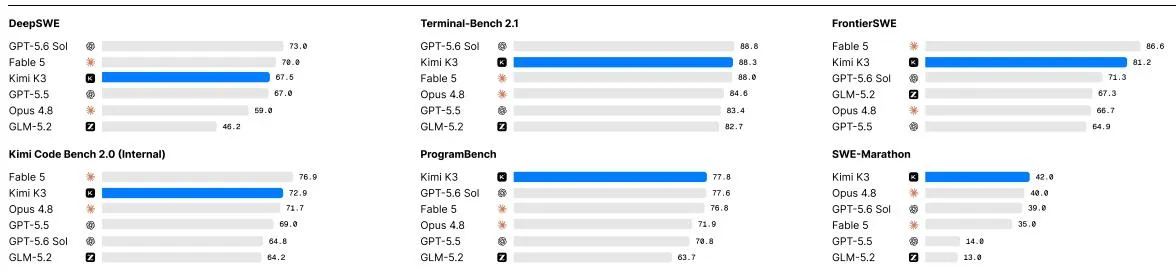
| DeepSWE | 67.5 | 70.0 | 73.0 | 59.0 | 67.0 | 46.2 |
| ProgramBench | 77.8 | 76.8 | 77.6 | 71.9 | 70.8 | 63.7 |
| Terminal-Bench 2.1 | 88.3 | 88.0 | 88.8 | 84.6 | 83.4 | 82.7 |
| FrontierSWE | 81.2 | 86.6 | 71.3 | 66.7 | 64.9 | 67.3 |
| SWE-Marathon | 42.0 | 35.0 | 39.0 | 40.0 | 14.0 | 13.0 |
| PostTrainBench | 36.6 | 41.4 | 34.6 | 34.1 | 28.4 | 34.3 |
| MLS-Bench-Lite | 48.3 | 49.9 | 46.2 | 42.8 | 35.5 | 40.4 |
| SciCode | 58.7 | 60.2 | 56.1 | 53.5 | 56.1 | 50.5 |
Kimi K3 在 ProgramBench (77.8) 和 SWE-Marathon (42.0,超 Fable 5 +7) 上取得 SOTA;Terminal-Bench 2.1 与 GPT-5.6 Sol 相差 0.5 pt。DeepSWE 官方 leaderboard 使用 mini-SWE-agent harness 时 Kimi K3 达 67.3。
Agentic (节选)
| Benchmark | Kimi K3 | Claude Fable 5 | GPT-5.6 Sol | Claude Opus 4.8 | GPT-5.5 | GLM-5.2 |
|---|---|---|---|---|---|---|
| BrowseComp | 91.2 | 88.0 | 90.4 | 84.3 | 84.4 | - |
| DeepSearchQA (F1) | 95.0 | 94.2 | - | 93.1 | - | - |
| ResearchRubrics | 76.2 | - | 73.8 | 73.5 | 64.0 | 71.1 |
| GDPval-AA v2 (Elo) | 1686 | 1747 | 1736 | 1593 | 1491 | 1510 |
| Toolathlon-Verified | 76.5 | 77.9 | 74.9 | 76.2 | 73.5 | 59.9 |
| MCPMark-Verified | 94.5 | 87.4 | 92.9 | 76.4 | 92.9 | - |
| MCP-Atlas | 84.2 | 84.7 | 83.6 | 83.6 | 82.8 | 82.6 |
| AutomationBench | 30.8 | 29.1 | 29.7 | 27.2 | 22.7 | 12.9 |
| JobBench | 54.3 | 57.4 | 45.4 | 48.4 | 38.3 | 43.4 |
| AA-Briefcase (Elo) | 1548 | 1583 | 1495 | 1354 | 1158 | 1260 |
| Agents’ Last Exam | 28.3 | 25.7† | 29.6 | 27.0 | 26.6 | 20.4 |
| OSWorld-Verified | 84.8 | 85.0 | 83.0 | 83.4 | 79.0 | - |
| OSWorld 2.0 | 58.3 | 66.1 | 62.6 | 55.7 | 49.5 | - |
| τ³-Banking | 33.4 | 26.8 | 33.0 | 27.6 | 31.3 | 26.8 |
| Harvey Lab-AA | 94.6 | 93.6 | 87.2 | 91.1 | 86.3 | 91.0 |
| CorpFin v2 | 71.6 | 71.8 | 64.4 | 66.7 | 68.4 | 66.1 |
| SpreadsheetBench 2 | 34.8 | 34.7 | 32.4 | 31.6 | 29.1 | 28.1 |
BrowseComp 上启用 300K token 触发的 context compaction 得 91.2;关闭 compaction 使用整个 1 M 窗口得 90.4。
Vision
| Benchmark | Kimi K3 | Claude Fable 5 | GPT-5.6 Sol | Claude Opus 4.8 | GPT-5.5 |
|---|---|---|---|---|---|
| WorldVQA ForceAnswer | 51.0 | 56.7 | 41.8 | 39.1 | 38.5 |
| OmniDocBench | 91.1 | 89.8 | 85.8 | 87.9 | 89.4 |
| PerceptionBench | 58.5 | 57.2 | 59.7 | 47.2 | 55.8 |
| Video-MME (w/ sub) | 90.0 | - | 89.5 | 86.0 | 89.3 |
| MMVU | 82.1 | - | 81.2 | 79.2 | 81.7 |
| BabyVision w/ Python | 85.7 | 90.5 | 88.9 | 81.2 | 83.6 |
| MMMU-Pro (no / w/ Python) | 81.6 / 83.4 | 81.2 / 86.5 | 83.0 / 84.6 | 78.9 / 82.7 | 81.2 / 83.2 |
| CharXiv (RQ, no / w/ Python) | 84.8 / 91.3 | 88.9 / 93.5 | 84.6 / 89.1 | 80.5 / 89.9 | 84.1 / 89.0 |
| Math-Vision (no / w/ Python) | 94.3 / 97.8 | 94.8 / 98.6 | 95.8 / 97.8 | 86.7 / 97.1 | 92.2 / 96.8 |
| ZeroBench-main pass@5 (no / w/ Py) | 23.0 / 41.0 | 23.0 / 46.0 | 17.0 / 35.0 | 17.0 / 34.0 | 22.0 / 41.0 |
内部评估(Kimi 自建 benchmark)
| Benchmark | Kimi K3 | Claude Fable 5 | GPT-5.6 Sol | Claude Opus 4.8 | GPT-5.5 | GLM-5.2 |
|---|---|---|---|---|---|---|
| Kimi Code Bench 2.0 (Claude Code) | 73.7 | 76.9 | - | 71.7 | - | 64.2 |
| Kimi Code Bench 2.0 (Kimi Code) | 72.9 | - | - | - | 66.0 | - |
| Coding Experience (Claude Code) | 59.9 | 59.8 | - | 58.0 | - | 53.3 |
| 24/7 ClawBench 2.0 | 48.3 | 47.4 | 52.0 | 47.2 | 48.5 | 43.2 |
| MIRA Bench | 64.1 | 72.9 | 62.2 | 59.8 | 54.6 | - |
| KAET | 83.5 | - | 85.4 | 78.7 | 79.7 | 74.7 |
| CLIF Bench | 52.4 | - | 50.6 | 48.8 | 52.3 | 39.2 |
| Agentic Vision Bench | 78.3 | 81.1 | 82.9 | 82.8 | 76.9 | - |
| Swarm Bench | 76.3 | - | 73.2 | 72.6 | 61.8 | 58.5 |
| Online Experience | 77.9 | 74.2 | 84.0 | 69.4 | 73.7 | 64.0 |
| Deep Research Bench | 90.0 | - | 85.3 | 87.2 | 81.9 | 84.0 |
| Finance Bench | 62.6 | - | 62.7 | 60.7 | 58.4 | 55.4 |
| DECK Bench | 73.5 | 73.0 | 74.7 | 66.9 | 68.2 | 68.6 |
| Faithfulness (1-hallucination) | 85.5 | - | 84.8 | 83.6 | 86.5 | 74.8 |
Kimi Webdev Bench(Kimi K3 vs Claude Opus 4.8,盲评):
| Domain | Win | Tie | Lose | Win − Lose |
|---|---|---|---|---|
| Games | 55.6% | 3.7% | 40.7% | +14.9% |
| 3D / WebGL / Shader | 72.7% | 13.7% | 13.6% | +59.1% |
| Website / UI Clone | 52.6% | 21.1% | 26.3% | +26.3% |
| Overall | 58.6% | 13.8% | 27.6% | +31.0% |
网络安全评估(Tier 1 + Tier 2)
- Tier 1(漏洞发现):在数十个广泛部署系统(OS kernel / DB / AI service / Web framework / blockchain / VPN)中发现数百个候选漏洞,人工复核确认率约 70%,其中包含 16 个 6 个项目的 0-day;两个 Linux kernel 案例:远程可触发 heap OOB write(远程 DoS)+ RDMA 子系统 Dirty-COW 类本地提权。
- Tier 2(exploit 开发):36 个任务分 user-space (16) + Linux kernel (20)。Kimi K3 解 14/36 (38.9%) vs GLM-5.2 8/36 (22.2%);14 个成功中 10 个来自 user-space 轨道;每个任务人工专家需 ~15 h(全套 540 h)。
- 失败模式:(i) 已获 primitive 后未能完成 exploit chain 最后一步;(ii) mitigation 下策略选择差(坚持 control-flow hijack 而非 data-only);(iii) 陷入长时间无产出 debug loop;(iv) 提交前 verification 不足。
- UK AISI + NIST CAISI 联合评估:ExploitBench 32% vs GLM-5.2 24%;32-step 模拟企业网络 17 vs 11 步;41 个 end-to-end exploit 全为 0 完成,仍落后 frontier 模型。
第三方评估(2026-07-23 起)
| Source | Metric | Kimi K3 | Claude Fable 5 | GPT-5.6 Sol | Claude Opus 4.8 | GPT-5.5 | GLM-5.2 |
|---|---|---|---|---|---|---|---|
| Artificial Analysis Intelligence Index v4.1 (#4/580) | AAII | 57.1 | 59.9 | 58.9 | 55.7 | 55.0 | 51.1 |
| Vals AI Index (#2/39) | % | 74.7 | 75.1 | 73.1 | 70.4 | 68.0 | 65.0 |
| WebDev Arena Elo (#1/99) | Elo | 1,678 | 1,634 | 1,630 | 1,565 | 1,507 | 1,592 |
| Text Arena Elo (#8/200) | Elo | 1,486 | 1,507 | 1,485 | 1,484 | 1,482 | 1,469 |
| Agent Arena (#4/37) | score | 9.1 | 12.7 | 10.1 | 9.8 | 8.8 | 6.5 |
Kimi K3 是首个登顶 WebDev Arena 的开源模型。
成本效率
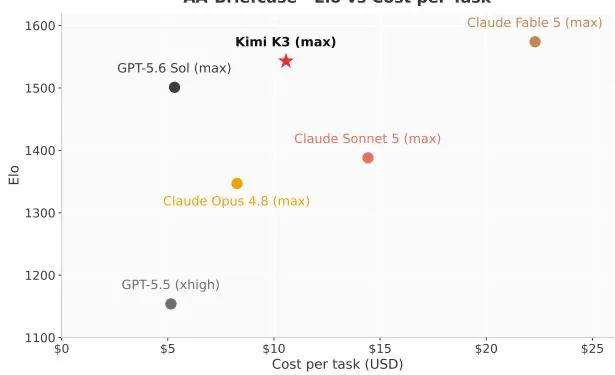
- Kimi Code Bench 2.0:落后 Fable 5 4.0 pt 但 成本仅 38%;high effort 已经追平 Opus 4.8 的 max,成本约 1/3。
- BrowseComp:最高 91.2 分 @ $2.03/task,比 GPT-5.6 Sol 便宜一半,比 Claude 系列在 max 便宜一个数量级。
- GDPval-AA v2:与 GPT-5.6 Sol 相差 <50 Elo 但成本低 13%;比 Fable 5 便宜 2.6×。
- AA-Briefcase:分数第二,成本约为 Fable 5 的一半。
消融/案例研究
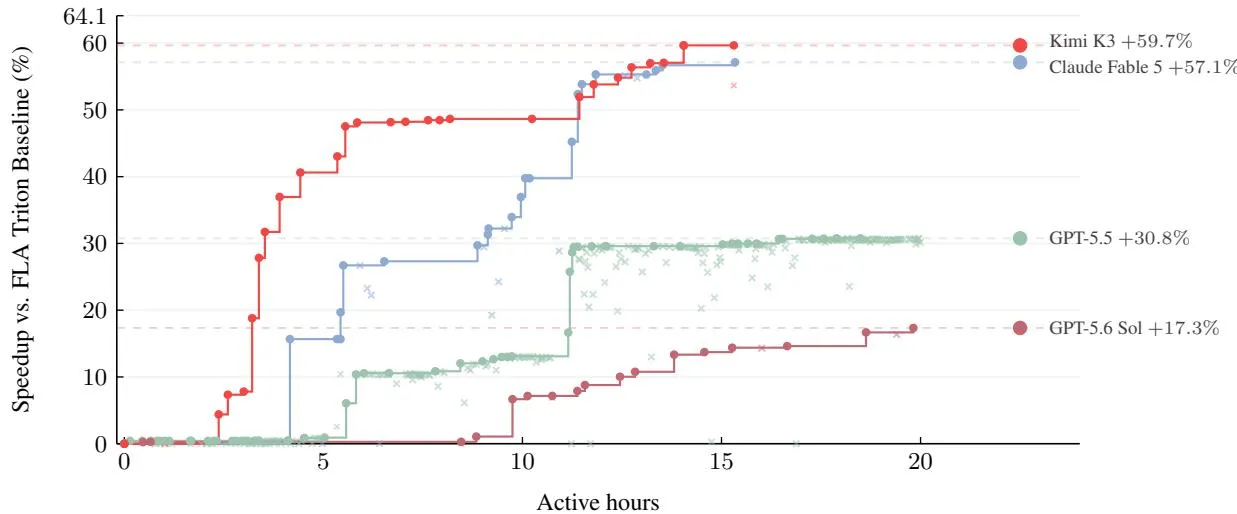
- GPU Kernel Optimization(24 h budget,四个 kernel:AttnRes / DSA / KDA / MLA head=512):Kimi K3 全面提升,AttnRes 从 283.6 ms → 114.4 ms、DSA -55.1%、KDA -73.6%、MLA 达到 >50% peak TFLOPS;打平 Claude Fable 5 (fallback),超 Opus 4.8 / GPT-5.6 Sol / GPT-5.5。图 14 显示 Kimi K3 在 20 h 达到 +59.7% 提升(Fable 5 +57.1%)。
- MiniTriton 编译器(Case Study,Figure 15):DSL frontend + MLIR + PTX + autograd + NCCL;L20 上超 torch eager / torch.compile 几何平均;tensor-core matmul 达机器 roof ~90%;DSL KDA prefill 内核显著超 Triton reference;训练 GPT,梯度差异 <torch fp32 舍入误差 。
- Nano-KPU 芯片设计(48 h 自主):hybrid KDA + NoPE-MLA + Block AttnRes (block=2) + sigmoid MoE (1 shared),group-wise INT4 (group=128);4 mm²、Nangate45、100 MHz timing closure,RTL decode >8,700 tokens/s,1.46 M cells + 0.277 MiB SRAM + INT4 MAC + fused dequant。
- I–Love–Q 关系复现:审阅 20+ 论文、300+ equations of state、3,000+ 行 Python、发现已发表公式错误 → 约 2 小时 vs 人类 1–2 周。
- Kimi Work 大型 deliverables:42 年 AI ASIC 行业调研(120+ 迭代 / 2,800+ 搜索 / 1,100+ terminal 查询 / 87 季报 + 99 PDF>11,000 页);GWTC-5 391 次引力波事件 + 20+ 并发 subagents。
- 视频剪辑:3Blue1Brown 风格架构解释视频 + 56 clips 拼接。
与现有方法对比
| 维度 | Kimi K2 | Kimi K3 | 变化 |
|---|---|---|---|
| 总参数 / 激活 | 1.04T / 32.6B | 2.78T / 104.2B | ↑167% / ↑220% |
| 层数 | 61 | 93 | ↑52% |
| Routed / Active experts | 384 / 8 | 896 / 16 | ↑133% / ↑100% |
| Shared experts | 1 | 2 | ↑100% |
| Attention Heads | 64 | 96 | ↑50% |
| Attention 机制 | MLA | Hybrid KDA + MLA (NoPE) | 全新 |
| Activation | SwiGLU | SiTU-GLU | 引入软 cap |
| 训练上下文 | 128 K | 1 M | 8× |
| Native Vision | ✗ | ✓ (MoonViT-V2 from scratch, 401M, 27L) | 新增 |
| Scaling Efficiency | 1× | ~2.5× | — |
| RL 结构 | 单一 | 9 experts (3 domains × 3 effort) + MOPD | 新增 |
| Quantization | — | MXFP4/MXFP8 QAT throughout post-training | 新增 |
| Sandbox | container | AgentENV microVM (133 ms/49 ms checkpoint) | 新增 |
七、相关工作
- Kimi 系列:Kimi K1.5 [118](RL scaling with LLMs)、Kimi K2 [58](Open Agentic Intelligence,1.04 T MoE + MLA)、Kimi K2.5 [59](Visual Agentic Intelligence + Agent Swarm)、Kimi Linear [63](KDA 原型)、Kimi-VL [61]、Kimi Work、Perception Bench [62]。
- KDA 前身:DeltaNet [105] / GDN [138] / Mamba-2 [24]、Kimi Linear [63](低秩输出门 + Softplus decay)、RWKV-7 [91]、HGRN2 [97]、Griffin [27]。
- MoE:DeepSeekMoE [23]、DeepSeek-V2 [28]、Switch Transformers [33]、GShard [66]、LatentMoE [32]、SonicMoE [41]、Step 3.5 Flash [47]、UltraEP [132]、DeepEP [147]、Expert Threshold Routing [112]。
- MLA / Attention:DeepSeek-V2/V3/V4 [28, 30, 29]、Ring Attention [72]、Flash Linear Attention [139]、LASP / LASP-2 [113, 114]、Gated Attention [99]。
- On-Policy Distillation:Kevin Lu / Thinking Machines Lab [75]、MiMo-V2 [134]、DeepSeek-V4 [29]。
- RL for LLMs:DeepSeek-R1 [40]、OpenAI o-series [83, 84]、Anthropic extended thinking [6, 7]、GLM-5.2 [37]。
- Speculative Decoding:EAGLE-3 [71]、LK Losses [104]、ReplaySSM [25]、WarpDecode [12]。
- Sandbox / Infra:Firecracker [3]、Mooncake Transfer Engine [96]、DADI/OverlayBD [68]、ZeRO [100]、Megatron-LM [81]、GPipe [48]、Muon [53, 73]、DeepSpeed Ulysses [50]。
- Multimodal Encoders:SigLIP-initialized ViT、MoonViT-3D、CharXiv [130]、Math-Vision [128]、ZeroBench [102]、Video-MME [36]、OmniDocBench [88]。
- Benchmarks:Terminal-Bench [78]、FrontierSWE [35]、SWE-Marathon [117]、BrowseComp [131]、DeepSearchQA [126]、ResearchRubrics [106]、Toolathlon [69, 119]、MCPMark [133]、AA-LCR/Briefcase [9, 2]、GDPval [90]、Agents’ Last Exam [4, 115]、GPQA [101]、HLE [93]、SciCode [121]、OSWorld [136, 143]。
八、总结
核心贡献
- 开源前沿预训练:训练出 2.8 T 总参数 / 104.2 B 激活的原生多模态 MoE,1 M token 上下文;KDA、AttnRes、Stable LatentMoE、SiTU-GLU、Per-Head Muon、精炼数据与训练配方联合带来 ~2.5× scaling efficiency 提升。
- 多 effort 测试时扩展的 RL:跨 general / agentic / coding 三领域 × 三 reasoning-effort 级共训练 9 位专家,并通过 Multi-Teacher On-Policy Distillation 汇入单一模型;引入 Reasoning-Effort RL、Agentic GRM + verbosity budget、Autonomous Execution Tasks。
- 多万亿参数百万 token 基础设施:KDA 系统协同(FlashKDA、KCP、状态感知 prefix cache)、MoonEP 完美负载 EP、memory-efficient MoE 训练、AgentENV microVM sandbox、cache/budget-aware fleet scheduling。
- 开源前沿模型:完整开源 Kimi K3 权重,成为世界首个开源 3T 类模型、首个登顶 WebDev Arena 的开源模型;Artificial Analysis Intelligence Index v4.1 = 57.1(第 3/580)。
技术影响
- 证明在同一模型内可同时扩展训练时参数与测试时 reasoning + agentic RL,开源生态无需在两轴之间取舍。
- KDA + NoPE + AttnRes 组合展示了长上下文、无 RoPE、稳定训练的一条可行路径;SiTU-GLU + RMSNorm + QB 让 896-expert 极稀疏 MoE 稳定收敛。
- MOPD 将 domain × effort 多专家融合为单模型的做法为 post-training 汇合范式提供成熟蓝本。
- MoonEP 的 冗余上限证明与 zero-copy static-shape 通信为大规模 EP 提供了可移植的最佳实践。
- AgentENV + 51,219,741 sandboxes × 1,505,678 images 展示了 microVM 支撑百万 trajectory agentic RL 的工程范式。
- 案例研究(MiniTriton、Nano-KPU)显示前沿开源模型已具备端到端编译器与芯片设计的自主生成能力,突破 kernel-optimization 层级。
局限性
- HLE-Full / CritPt:research-level reasoning 仍落后于 Claude Fable 5 / GPT-5.6 Sol(HLE-Full 43.5 vs 53.3;CritPt 23.4 vs 32.3)。
- GDPval-AA v2 / AA-Briefcase / JobBench:Elo 型知识工作评估仍落后 Claude Fable 5。
- 网络安全 Tier 2 kernel exploitation:无论 Kimi K3 还是 GLM-5.2 均未能解出 3/4 的 kernel exploit 任务;AISI/CAISI 报告显示 41 个 end-to-end exploit 全为 0 完成。
- 失败模式:exploit chain 收尾、mitigation 下策略选择、debug loop 陷入、submission 前的自 verification。
- 专有旗舰仍领先:整体能力上仍逊于 Claude Fable 5 与 GPT-5.6 Sol。
- 1 M 长上下文成本:一次 personal-assistant rollout 可达上千工具调用 + 百万 token,仍高度依赖专用 infra(KCP / prefix cache / AgentENV)。
九、参考资源
- 论文:arXiv:2607.24653 – Kimi K3: Open Frontier Intelligence · PDF
- 模型 & Blog:www.kimi.com/blog/kimi-k3
- Kimi CLI:www.kimi.com/code
- 相关论文:
- Kimi K1.5 – arXiv:2501.12599
- Kimi K2 – arXiv:2507.20534
- Kimi K2.5 – arXiv:2602.02276
- Kimi Linear – arXiv:2510.26692
- Kimi-VL – arXiv:2504.07491
- 代码仓库:
- MoonEP – github.com/MoonshotAI/MoonEP
- FlashKDA – github.com/MoonshotAI/FlashKDA
- MiniTriton – github.com/MoonshotAI/minitriton
- Nano-KPU – github.com/MoonshotAI/nano-kpu
- AgentENV – github.com/kvcache-ai/AgentENV
- Flash Linear Attention – github.com/fla-org/flash-linear-attention
- 参考基础设施 & 论文:
- Muon – kellerjordan.github.io/posts/muon
- EAGLE-3 – arXiv:2503.01840
- DeepSeekMoE – arXiv:2401.06066
- DeepSeek-V3 – arXiv:2412.19437
- Mooncake – arXiv:2407.00079
- Firecracker – NSDI 2020
- LatentMoE – arXiv:2601.18089
- SonicMoE – arXiv:2512.14080
- 第三方评估:
- Artificial Analysis – artificialanalysis.ai
- Vals AI – vals.ai
- LMArena – lmarena.ai/leaderboard
- Agents’ Last Exam – agents-last-exam.org/leaderboard
- AISI/CAISI – aisi.gov.uk/blog/preliminary-assessment-of-kimi-k3s-cyber-capabilities
- 图片索引:figures/kimi-k3/README.md