Redesigning GROMACS Halo Exchange: Improving Strong Scaling with GPU-initiated NVSHMEM
GPU-initiated NVSHMEM redesign of GROMACS domain decomposition halo exchange, fusing data packing and communication to eliminate CPU-GPU sync bottlenecks and improve strong scaling by up to 2x
Redesigning GROMACS Halo Exchange: Improving Strong Scaling with GPU-initiated NVSHMEM
一、论文概述
| 项目 | 内容 |
|---|---|
| 标题 | Redesigning GROMACS Halo Exchange: Improving Strong Scaling with GPU-initiated NVSHMEM |
| 作者 | Mahesh Doijade (NVIDIA), Andrey Alekseenko (KTH), Ania Brown (NVIDIA), Alan Gray (NVIDIA), Szilard Páll (KTH) |
| 机构 | NVIDIA / KTH Royal Institute of Technology |
| 论文 | https://arxiv.org/abs/2509.21527 |
| 代码 | 未公开(已 upstreaming 到 GROMACS) |
| 发布 | PAW-ATM Workshop at SC 2025, Sept 25, 2025 |
| 许可 | CC BY-SA 4.0 |
| 类别 | cs.DC (Distributed Computing) |
二、核心思想
问题定义
分子动力学(MD)模拟的强扩展面临严重的延迟挑战。GROMACS 是高度延迟敏感的应用,峰值迭代率在亚毫秒级(100-200 µs/step)。在异构超级计算机上,MPI 的 CPU 中心化特性在 GPU 驻留应用的关键路径上引入了额外延迟:
- CPU-GPU 同步开销:每个 halo exchange 脉冲都需要 GPU kernel 完成 → CPU 等待 → MPI 发送 → CPU 等待 → GPU 接收数据 → GPU kernel 启动
- MPI 无法从 GPU kernel 调用:MD 步骤无法完全 GPU 驻留
- 序列化脉冲:z → y → x 三维通信阶段必须串行执行,每步都需 CPU-GPU 同步
- 内核启动延迟累积:约 20 次启动 API 调用 + 30 次事件管理调用,累积成本可达 CPU 壁时间的 50%
解决方案概述
本文提出了一种基于 NVSHMEM 的 GPU kernel 发起的 GROMACS 域分解 halo exchange 算法重构。核心创新包括:
- GPU 驻留设计:所有通信控制路径卸载到 GPU,消除 CPU-GPU 同步瓶颈
- Fused 内核:将数据打包(pack)和通信融合到单个 kernel 中,最大化通信并发
- 依赖分区策略:将索引映射分为
depOffset以上(独立数据)和以下(依赖数据),独立数据立即打包发送,依赖数据仅等待必要的脉冲 - TMA 异步复制引擎:NVLink 路径使用 Tensor Memory Accelerator 实现 warp 级别的异步远程内存操作
- 自适应互连策略:NVLink 路径使用零拷贝直接远程访问;InfiniBand 路径使用粗粒度的 put-with-signal 和 staging buffer
- 融合信号与通信:在单个 kernel 内完成数据打包/传输和接收方通知,不同于典型 NVSHMEM 实现
模型在 NVIDIA EOS(576 个 DGX H100 节点)和 GB200 NVL72 系统上验证,NVLink 上 intra-node 最高提升 1.5x,multi-node 最高提升 2x,NVLink+InfiniBand 上提升 1.3x。
三、技术架构
GROMACS 域分解 Halo Exchange
GROMACS 使用中性领土域分解(Neutral-Territory Domain Decomposition):
- 模拟盒子划分为空间区域(domains),每个 MPI rank 负责其分配区域内原子的受力计算
- 非键相互作用由 cutoff 限制范围,边界原子需要相邻域的坐标
- 采用八壳转发方法(eighth-shell method):边界数据通过中间 rank 转发,而非直接发送到所有消费者
通信阶段:
- np(z) 个脉冲在 z 方向
- np(y) 个脉冲在 y 方向
- np(x) 个脉冲在 x 方向
转发机制确保 np(x) × np(y) × np(z) - 1 个相邻 rank 的数据交换仅需 np(x) + np(y) + np(z) 步。
NVSHMEM vs MPI 调度对比
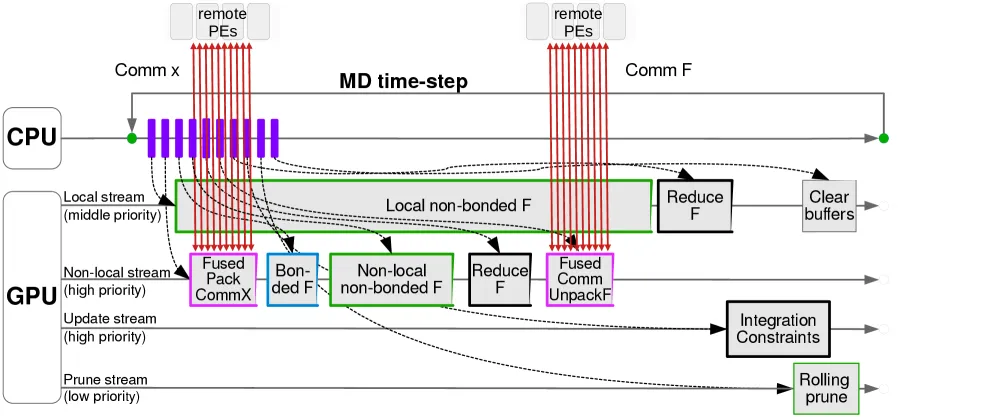
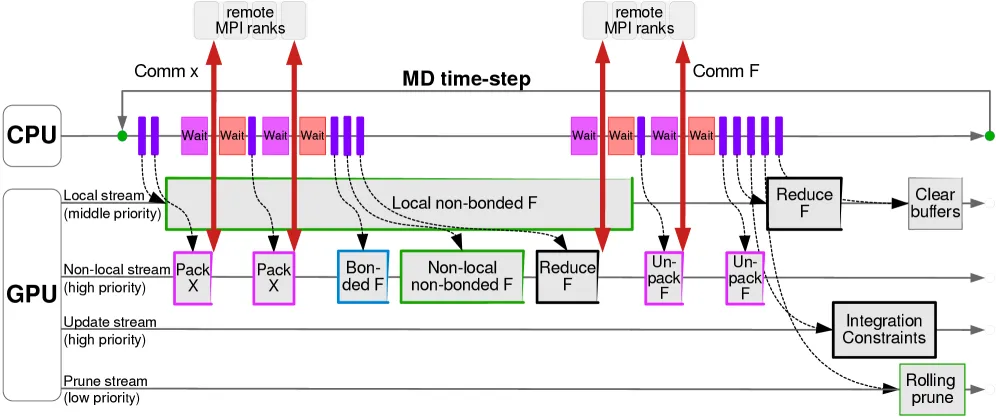
MPI 方案(Fig. 1):
- CPU MD 时间步进循环中,紫色框 = kernel 启动,品红色 = GPU pack/unpack 等待,红色 = MPI 通信等待
- 每个脉冲都需要 CPU-GPU 同步,关键路径暴露大量等待
NVSHMEM 方案(Fig. 2):
- CPU 时间步进循环中的 kernel 启动可与计算完全重叠
- GPU stream 中本地/非本地工作完全重叠,halo exchange 不在关键路径上
核心数据结构(Algorithm 1)
PulseData (per pulse):
  sendRank, recvRank, sendSize, recvSize
  atomOffset, coordShift, indexMap
  remoteCoordDst, remoteForceDst, remoteForceSrc
  sendBuf, recvBuf, blocksForPulse

CommContext:
  totalPulses, signal[p], sigVal
  // Runtime path: NVLink when remoteCoordDst/remoteForceSrc non-null
  // Otherwise InfiniBand with NVSHMEM put-with-signal

Signals: device-visible counters indexed by pulse id
Buffers: coords, forces, per-pulse staging buffers
Barriers: indexMapLoadBarrier, forceBufLoadBarrier
Helper: isNVLinkAccess(ptr) ≔ (ptr ≠ null)
GPU 驻留时间步骨架(Algorithm 2)
// Fused NVSHMEM halo exchange — single launch per coord/force exchange
launch Local Non-bonded F on local stream
launch FusedPackCommX on non-local stream
    // Coordinate halo: pack, NVLink TMA store or InfiniBand put-to-remote, then notify
launch Bonded F on non-local stream
launch Non-Local Non-bonded F on non-local stream
launch FusedCommUnpackF on non-local stream
    // Forces halo: NVLink get-from-remote or InfiniBand put-to-remote; notify; then unpack
launch Integration, constraints on update stream
launch other per-step work: ReduceF, Rolling prune, Clear buffers
proceed to next step without CPU-GPU sync (GPU-resident schedule)
坐标 Halo 交换:FusedPackCommX(Algorithm 3)
// Kernel: FusedPackCommX
// blocks with same blockIdx.y cooperate on current pulse p
for p ← blockIdx.y to ctx.totalPulses-1 step gridDim.y do
    meta ← pulses[p];
    outBuf ← (isNVLinkAccess(meta.remoteCoordDst))
              ? shared-mem scratch : meta.sendBuf;
    needLastBlock ← (meta.blocksForPulse > 1)

    packWithDeps(meta, ctx, p, outBuf)    // Algorithm 4

    if isNVLinkAccess(meta.remoteCoordDst) then
        // As chunks are ready: TMA async store
        tma_st(outBuf → meta.remoteCoordDst + meta.atomOffset)
            // issued by thread 0 of each warp (warp leader)
    end if

    syncAndCommWithDeps(DATA, needLastBlock, ctx, meta, p, pulses,
                        outBuf, null, coords)  // Algorithm 5
end for
依赖感知打包(Algorithm 4)
// Device Function: packWithDeps
pack all entries with meta.indexMap[i] < meta.depOffset into outBuf
    // Apply meta.coordShift as needed

elect a leader at chosen scope
    // warp leader for NVLink path, threadIdx.x=0 otherwise

leader: for k ← p-1 down to firstDependentPulse
    acquire_wait(ctx.signal[k] == ctx.sigVal)

scope_barrier()
    // SYNCWARP() for NVLink; SYNCTHREADS() for InfiniBand

pack remaining entries with meta.indexMap[i] ≥ meta.depOffset into outBuf关键洞察:通过将索引映射在 depOffset 处分割,独立数据的打包和通信可以立即进行,而依赖数据只需等待前一个脉冲的信号。这使得所有脉冲能够并行推进,同时保持必需的顺序关系。
全局脉冲顺序按 Z→Y→X 维度连接定义:
firstDependentPulse(z0)= nonefirstDependentPulse(y0)= z0firstDependentPulse(x0)= y0
NVLink 路径:TMA 流水线打包+远程存储
NVLink 上,kernel 使用 warp 级 TMA 远程存储将打包与通信流水线化:
- 每个 threadblock 内的每个 warp 将坐标的专用 chunk 打包到共享内存
- 尊重 TMA 合并的 128-byte 对齐要求和 float3 布局
- 作为 chunk 打包完成,选出的 warp leader 发出异步 TMA 存储操作
- 其他 warp 可以继续打包 — 解耦了 warp 间的进度,避免 block 级同步
使用 cuda::ptx::cp_async_bulk 驱动 TMA 引擎。TMA 自主处理传输,释放 SM 资源用于计算。
InfiniBand 路径:staging buffer + put-with-signal
对于 InfiniBand,kernel 仍使用 packWithDeps 基于依赖分区工作:
- 将坐标打包到全局内存中的 staging buffer
- 通过
nvshmem_float_put_signal_nbi发出远程 put - 独立数据立即打包,依赖数据通过信号同步等待
- 重叠独立数据打包与依赖解析
Force Halo 交换:FusedCommUnpackF(Algorithm 6)
// Kernel: FusedCommUnpackF
for p ← ctx.totalPulses - 1 - blockIdx.y down to 0 step -gridDim.y do
    meta ← pulses[p]  // reverse send/recv roles vs coordinates

    if p = ctx.totalPulses-1 and first thread then
        syncAndCommWithDeps(DATA, false, ctx, meta, p, pulses,
                            meta.recvBuf, &forces[meta.atomOffset], null)
    end if

    dataSize ← (meta.remoteForceSrc ? meta.recvSize : meta.sendSize)
    bufLength ← 2048; chunkOffset ← blockIdx.x × bufLength
    chunkSize ← min(bufLength, dataSize - chunkOffset)

    Initialize shared memory buffers and barriers

    if threadIdx.x == 0 and chunkOffset < dataSize then
        tma_ld(smemMap ← meta.indexMap + chunkOffset, chunkSize,
               indexMapLoadBarrier)
        acquire_wait(ctx.signal[p] == ctx.sigVal)
    end if

    if isNVLinkAccess(meta.remoteForceSrc) then
        tma_ld(smemF ← meta.remoteForceSrc + meta.atomOffset + chunkOffset,
               bufLength, forceBufLoadBarrier)
        forceBufLoadBarrier.arrive_and_wait()
    end if

    indexMapLoadBarrier.arrive_and_wait()

    // Parallel accumulation across threads
    for each received entry: map to target atom index using index map
        write/accumulate into forces (use atomicAdd when accumulating)

    if p > 0 then
        syncAndCommWithDeps(DEP_MGMT, true, ctx, meta, p, pulses,
                            null, &forces[0], null)
    end if
end for关键设计:从最后一个脉冲的已计算受力开始,沿依赖链向后工作。使用 atomicAdd 在所有脉冲上并行解包,最小化依赖 prior pulse 的数据的等待时间。
融合信号与内存排序
不同于典型 NVSHMEM 实现的重要创新:将数据打包/传输与接收方通知融合在单个 kernel 中(通过 syncAndCommWithDeps):
// syncAndCommWithDeps (Algorithm 5)
block_barrier(); only threadIdx.x = 0 proceeds to notify

if needLastBlock then
    old ← atomicIncReleaseGpu(blockCompletionCounter[p])
    if old ≠ meta.blocksForPulse-1 return
end if

if isNVLink then
    hasDataWrites ? system_release_store(receiverSignal, ctx.sigVal)
                  : system_relaxed_store(receiverSignal, ctx.sigVal)
else  // InfiniBand
    nvshmem_float_put_signal_nbi(dest, src, size, receiverSignal,
ctx.sigVal, sendRank)- NVLink:
system_release_store确保前置数据写入可见;system_relaxed_store用于无需刷新的场景 - InfiniBand:
nvshmem_float_put_signal_nbi非阻塞 put-with-signal - 仅从最后一个 block 发射 system-scope 操作,最小化开销
层级同步优化
Receiver Notification = Data Transfer Kernel 内部融合
↓
Per-pulse ordering enforced through:
  - GPU-scope release atomic increment (block completion counter)
  - System-scope acquire/release stores (NVLink)
  - Put-with-signal (InfiniBand)
四、核心公式
通信脉冲数
对于 D 维域分解(np(x), np(y), np(z)):
依赖关系
firstDependentPulse(z₀) = none
firstDependentPulse(y₀) = z₀
firstDependentPulse(x₀) = y₀
TMA 合并要求
- 对齐粒度:128 bytes
- 数据类型:float3
- Warp leader 模式:每个 warp 的 thread 0 发出 TMA 操作
内存排序语义
// NVLink: system scope acquire-release
system_release_store(receiverSignal, ctx.sigVal)   // data writes visible
system_relaxed_store(receiverSignal, ctx.sigVal)   // no prior writes to flush

// InfiniBand: put-with-signal
nvshmem_float_put_signal_nbi(dest, src, size, signal, sigVal, rank)

// GPU scope atomic
atomicIncReleaseGpu(blockCompletionCounter[p])
关键性能指标
- Local work:local non-bonded kernel 的开始到结束
- Non-local work:第一个 pack 开始到最后一个 unpack 结束
- Non-overlap:local non-bonded kernel 结束到最后一个 unpack 结束(clamp 到 0)
- Time per step:总运行时间减去 Domain Decomposition 和 Neighbor Search 壁时间(每 200 步执行一次)
五、核心创新
| 创新点 | 说明 | 效果 |
|---|---|---|
| GPU 发起的 halo exchange | 首个将 GROMACS DD halo exchange 完全迁移到 GPU kernel 的方案 | 消除 CPU-GPU 同步瓶颈 |
| Fused 多脉冲内核 | 单个 kernel 并行处理所有维度脉冲,而非串行 | 减少 kernel 启动开销 |
| 依赖分区策略 | 索引映射在 depOffset 分割,独立数据立即发送 | 最大化通信并发 |
| TMA 流水线打包+传输 | Warp 级 TMA 远程存储,解耦 warp 间进度 | NVLink 上亚微秒级延迟 |
| 融合信号与通信 | 数据打包/传输和接收方通知在单个 kernel 内 | 不同于典型 NVSHMEM 实现 |
| 自适应互连策略 | 运行时根据 NVLink/InfiniBand 自动切换通信方式 | 跨硬件配置最优性能 |
六、实验结果
测试平台
NVIDIA EOS 超级计算机:
- 576 个 DGX H100 节点
- 每节点:2× Intel Xeon 8480C CPU + 8× H100 GPU
- 总计:4,608 个 GPU
- 节点内:NVLink 4.0 + NVSwitch
- 节点间:ConnectX-7 NDR 400G InfiniBand,rail-optimized 非阻塞全树拓扑
- CUDA 12.6.3, NVSHMEM 3.1.7 (IBRC transport)
GB200 NVL72 多节点 NVLink:
- 36×2 配置(72 个 GPU)
- 多节点 NVLink 直连
基准系统
Grappa 基准集(水-乙醇混合物),系统大小 45,000 到 4600 万原子:
- 45k, 90k, 180k, 360k, 720k, 1440k, 2880k, 5760k, 23040k 原子
使用反应场静电模型以聚焦短程交互和 halo exchange 分析。
Intra-node 性能对比(Fig. 3)
| 系统大小 | 4 GPUs | 8 GPUs |
|---|---|---|
| 45k (11.25k/GPU) | NVSHMEM +46% (1649 vs 1126 ns/day) | - |
| 180k (45k/GPU) | NVSHMEM +4% (1103 vs 1058 ns/day) | NVSHMEM +28% (1249 vs 973 ns/day) |
| 360k (90k/GPU) | 基本持平 (671 vs 670 ns/day) | NVSHMEM +17% (910 vs 779 ns/day) |
趋势:从小系统(通信主导)到大系统(计算主导),NVSHMEM 优势从 46% 降至 17%,反映 TMA 批量传输在计算不足以隐藏通信开销时的最大收益。
GB200 NVL72 强扩展(Fig. 4)
以单节点性能为基线(720k: 492 ns/day, 1440k: 272 ns/day):
720k 系统:
| 节点数 | GPU数 | ns/day | 并行效率 |
|---|---|---|---|
| 2 | 8 | ~414 | 84% |
| 4 | 16 | ~270 | 55% |
| 8 | 32 | ~157 | 32% |
1440k 系统:
| 节点数 | GPU数 | ns/day | 并行效率 |
|---|---|---|---|
| 2 | 8 | ~239 | 88% |
| 4 | 16 | ~193 | 71% |
| 8 | 32 | ~131 | 48% |
Multi-node 性能对比(EOS, Fig. 5)
| 系统 | 节点数 | NVSHMEM | MPI | 提升 |
|---|---|---|---|---|
| 720k | 8 | 1103 | 944 | +17% |
| 1440k | 16 | - | - | +12%, 效率 33% vs 31% |
| 5760k | 128 | - | - | 1.3x, 效率 15% vs 11% |
| 23040k | 288 | 716 | 633 | +13% |
设备侧时序分析(Fig. 6-8)
Intra-node(Fig. 6, 4 GPUs, 1D DD):
| 系统 | 原子/GPU | Local work | Non-local (MPI) | Non-local (NVSHMEM) | Non-overlap |
|---|---|---|---|---|---|
| 45k | 11.25k | ~22 µs | 116 µs | 64 µs | 116 µs → 64 µs |
| 180k | 45k | ~38 µs | 101 µs | 94 µs | - |
| 360k | 90k | ~152 µs | ~152 µs | ~152 µs | 接近完美重叠 |
Multi-node 11.25k/GPU(Fig. 7, 1D→2D→3D):
- 1D→2D:non-local work 变化 <11%(尽管脉冲数翻倍)
- 2D→3D:non-local time 增加 ~45%(与脉冲数 1.5x 增长一致)
Multi-node 90k/GPU(Fig. 8):
- 1D:NVSHMEM 完全重叠 local 和 non-local work
- 2D:NVSHMEM 比 MPI 快 ~24 µs(尽管 local kernel 慢 ~16 µs,但不在关键路径)
- 3D:NVSHMEM 比 MPI 快 50-60 µs(尽管 local kernel 慢 ~10 µs)
扩展极限分析
- 最优扩展点:~20k 原子/GPU(NVLink 和 NVLink+InfiniBand 均观察到)
- GPU 利用率限制:<10-25k 原子/GPU 时,不足以饱和现代 H100(>100 SMs)
- NVSHMEM 代价:SM 资源共享导致 local work 减慢 10-16 µs,但在大多数场景下被 non-local work 减少所补偿
七、相关工作
| 工作 | 关系 |
|---|---|
| GROMACS thread-MPI | 之前实现单节点异步通信,但不支持多节点 |
| cuFFTMp (GROMACS 2023) | 使用 NVSHMEM 的 PME 分解,为本工作奠定基础 |
| Stream-aware MPI | 粗粒度方法,难以利用 NVLink 细粒度能力 |
| NAMD + Charm++ | 早期使用 PGAS 降低 MD 延迟 |
| LAMMPS SHMEM | 先前探索过 SHMEM 在 MD 中的应用,但有对称分配缺点 |
| QUDA / PETSc / Kokkos | 其他使用 NVSHMEM 的应用,但未针对 MD halo exchange 优化 |
八、总结
核心贡献
- GPU 发起的 halo exchange:基于 NVSHMEM 的 GROMACS 中性领土域分解算法重构,融合 pack/unpack 和数据传输
- Fused 多脉冲设计:跨所有分解维度的通信阶段融合,通过独立/依赖数据的分离处理最大化并发
- 层级同步优化:接收方通知融合到数据传输 kernel 中
- 自适应互连策略:基于 NVLink/InfiniBand 的运行时自适应通信,TMA 异步复制引擎
- 全面性能评估:在 EOS(576 H100 节点)和 GB200 NVL72 上的强扩展研究
技术影响
- GPU 发起通信的普适价值:证明 GPU-initiated communication 对广泛延迟敏感应用的强扩展有深远益处
- 可复用性:类似 halo exchange 算法常见于 CFD、天体物理等领域,本工作的优化可被其他 HPC 代码复用
- GROMACS 未来方向:计划将此方法扩展到 PME 任务的坐标/力通信
局限性
- Rank specialization 不兼容:当前实现无法与多 PME rank 的 cuFFTMp 结合使用(NVSHMEM 全局对称分配模型限制)
- SM 资源竞争:GPU SM 用于同步和通信会与重叠计算产生资源竞争,在大输入小节点数场景下 MPI 略优
- Fully GPU-resident 未完成:目前某些不平衡 sync 仍需 CPU 同步,计划设计完全 GPU 驻留方案
- 仅单精度:基准使用反应场模型聚焦短程交互,长程 PME 交互未在本工作中覆盖
- 验证平台有限:主要在 EOS (H100) 和 GB200 NVL72 上验证,HPE Slingshot 11 仅在较小规模观察
九、参考资源
- arXiv: https://arxiv.org/abs/2509.21527
- HTML: https://arxiv.org/html/2509.21527
- PDF: https://arxiv.org/pdf/2509.21527
- DOI: https://doi.org/10.1145/3731599.3767508
- Artifact A2: https://doi.org/10.5281/zenodo.17062607
- 相关库: GROMACS - https://github.com/gromacs/gromacs/
- 相关论文: Doijade et al. 2025 - “GPU-initiated Halo Exchange using NVSHMEM in GROMACS” (Artifact A2 supplementary data)